
















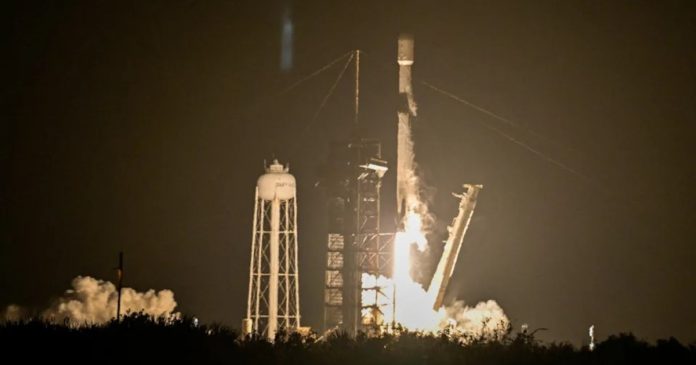

A discarded SpaceX Falcon 9 rocket stage is believed to have crashed into the Moon on Wednesday after spending months drifting through space. The unexpected impact, caused by shifting gravitational forces and solar activity, has given scientists a rare chance to study a fresh lunar crater and learn more about the growing challenge of space debris.
Key Takeaways
- A 4,000kg Falcon 9 upper stage is believed to have hit the Moon at around 8,690 km/h (5,400 mph).
- The rocket launched in January 2025 as part of a mission carrying Firefly Aerospace’s Blue Ghost and ispace’s Resilience lunar landers.
- Lunar orbiters are expected to capture images of the impact site over the next few days.
How a Rocket Ended Up on a Collision Course
The rocket wasn’t supposed to end its journey this way. After helping deliver two lunar landers, the Falcon 9 upper stage completed its mission and remained in space, as planned.
Unlike the reusable first-stage booster, this section had no way to return to Earth. Over time, a combination of gravity and solar activity slowly nudged it off course. With no fuel left to make corrections, the rocket continued drifting until it was pulled toward the Moon.

What SpaceX Says Happened
SpaceX says it followed the standard safety procedures after launch. However, the rocket’s path changed a long time after the mission had wrapped up.
“We did that,” said Julianna Scheiman, SpaceX’s Director of NASA Science and Dragon Programs. “But what has happened is essentially a mixture of solar activity and gravity forces that have put it on a path towards the moon.”
By the time astronomers confirmed the collision course, there was nothing anyone could do. The rocket was simply along for the ride.
Why Scientists Are Actually Excited
While the impact wasn’t intentional, researchers see it as a rare scientific opportunity. Fresh impacts on the Moon are difficult to observe, especially when scientists know exactly where and when they will happen.
NASA says the event poses “no danger to Earth.” Instead, researchers plan to study the new crater, the dust thrown into space and the way the lunar surface responds to high-speed impacts. Those findings could prove useful as future missions send astronauts and equipment back to the Moon.
Ground-based telescopes searched for a visible flash, but the collision happened too far away to capture clearly. Scientists are now waiting for lunar orbiters to fly over the site and send back images.
A Reminder That Space Is Getting Crowded
The incident has also put the spotlight on a growing issue beyond Earth’s atmosphere. Every launch leaves behind hardware, and not every piece finds its way safely home.
Experts have warned for years that abandoned rocket stages and other debris could create problems for future missions if left unmanaged. As more governments and private companies increase the number of launches, keeping space clear is becoming just as important as exploring it.
For SpaceX, NASA and other space agencies, the focus is now shifting toward better disposal methods that reduce the chances of similar incidents in the future.
FAQs
1. Did the SpaceX rocket threaten Earth?
NASA confirmed the impact by the SpaceX rocket posed no risk to Earth.
2. Why did the rocket crash into the Moon?
Gravity and solar activity gradually altered the rocket’s path after the mission ended.
3. Will the crash be visible?
Scientists expect lunar orbiters to photograph the impact site in the coming days.
Stay tuned to Brandsynario for latest news and updates



 Join a Channel
 Brandsynario
 Veryfilmi