











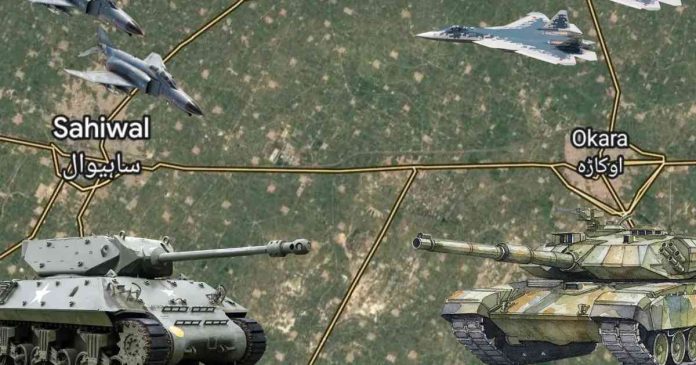

For three glorious days, Pakistan forgot about inflation, politics, cricket selection debates, and everything else that usually dominates social media.
Instead, the country found itself consumed by a conflict that did not exist.
There were missile strikes, military alliances and ceasefire negotiations. There were strategic trade routes, assassination plots, aerial combat operations, and even a fully functioning Iron Dome in Karachi.
None of it was real.
Yet millions of people followed every update as if South Asia had suddenly acquired two new superpowers: Okara and Sahiwal.
What began as a niche meme on social media rapidly evolved into one of the funniest and most creative examples of collective internet storytelling Pakistan has seen in years.
The Great Okara-Sahiwal War: How a Meme Became a War
Like most internet phenomena, the origins were surprisingly simple.
A satirical content ecosystem centered around “Channel67 Okara” began producing increasingly absurd content that portrayed Okara as a rapidly advancing global power. Within days, the city had apparently achieved technological breakthroughs that most nations could only dream of.
According to the fictional narrative, Okara had built bridges, launched astronauts into space, developed advanced agricultural technology, established a navy despite being completely landlocked, and created weapons powerful enough to alter the balance of power across Punjab.
The joke worked because every new claim was more ridiculous than the last.
Instead of questioning the premise, social media users embraced it and soon, the story needed an enemy.
That enemy became Sahiwal.
View this post on Instagram
The Escalation Nobody Could Stop
Once Sahiwal entered the storyline, events spiraled quickly.
According to the increasingly elaborate lore, June 3 marked the official beginning of hostilities. Missiles were allegedly launched toward Sahiwal.
A man riding a handmade bicycle was transformed into a stealth bomber. Kitchen utensils became precision-guided weapons. Nuclear capabilities appeared overnight. Robots entered the battlefield.
The absurdity was the point.
Every post attempted to outdo the previous one. Ordinary social media users transformed into war correspondents, military historians, and geopolitical analysts.
The more impossible the scenario became, the funnier it got.
The Formation of Two Great Powers
No conflict is complete without alliances, and the internet did not disappoint.
As the fictional war expanded, cities across Pakistan were drafted into competing camps.
The Sahiwal Alliance reportedly consisted of Lahore, Bahawalpur, Phoolnagar, Gujrat, Peshawar, Kohat, Chichawatni, and even the hilariously named “United Kingdom of Balochistan.”
Meanwhile, the Okara Alliance assembled an equally impressive coalition that included Karachi, Multan, Gujranwala, Islamabad, Quetta, Sheikhupura, Muridke, and Pattoki.
None of these alliances made geographical sense.
That only made them better.
At one point, social media users were debating the strategic importance of various cities with the seriousness usually reserved for NATO summits.
Then Donald Trump Entered the Conversation
Just when it seemed the conflict could not become any more absurd, international diplomacy entered the picture.
One widely shared update claimed Donald Trump had held “very good calls” with representatives from both Okara and Sahiwal and was pushing for an immediate ceasefire.
The proposed agreement reportedly included tariff reductions on Nili-Ravi milk exports and broader economic cooperation.
The statement sounded remarkably similar to actual geopolitical announcements.
Which made it even funnier.
At this point, the line between satire and international diplomacy had become almost impossible to distinguish.
View this post on Instagram
The joke worked because it perfectly mirrored the language often used in real-world geopolitical announcements.
By this point, nobody was pretending the story had any connection to reality.
The entertainment came from watching how far the narrative could be stretched before it completely collapsed under its own absurdity.
As it turned out, the limit did not exist.
As entertaining as the Great Okara-Sahiwal War was, there was a serious point behind it.
iVerify Pakistan and the IBA Centre for Excellence in Journalism used it for highlighting how misinformation spreads online. The ceasefire negotiations were fake.
Donald Trump’s involvement was definitely fake and yet people knowingly participated in the fiction.
But misinformation often spreads using the same mechanics. It creates urgency and feels believable enough to share. Then, it spreads rapidly through social networks. The difference is that satire invites people to laugh, while misinformation tries to convince them.
The message here is simple: think before you share.
Stay tuned to Brandsynario for latest news and updates