










For decades, Pakistani Television was not just a broadcaster; it was the country’s cultural conscience. Long before ratings, algorithms, and viral clips defined success, PTV defined what prime-time drama meant. Its studios produced stories rooted in social and moral dilemmas, class tensions, and everyday lives.
From the socially conscious serials of the 1970s to the classics of the 1980s and 1990s that still circulate on YouTube and in collective memory, PTV shaped a shared national imagination.
Today, however, as private channels dominate ratings and digital platforms measure success in billions of views, a familiar question comes to mind: what went wrong with PTV, and can it ever find its way back?
The Birth of a Cultural Institution
November 26, 1964, marks a defining moment in Pakistan’s media history. On this day, Pakistan Television Corporation began its broadcast from a pilot station in Lahore.
Initially operating under private management, with the Ministry of Information and Broadcasting holding the majority of shares, PTV soon became fully state-controlled after the 1971 war. What followed was a period of heavy government investment under the banner of communication network expansion.
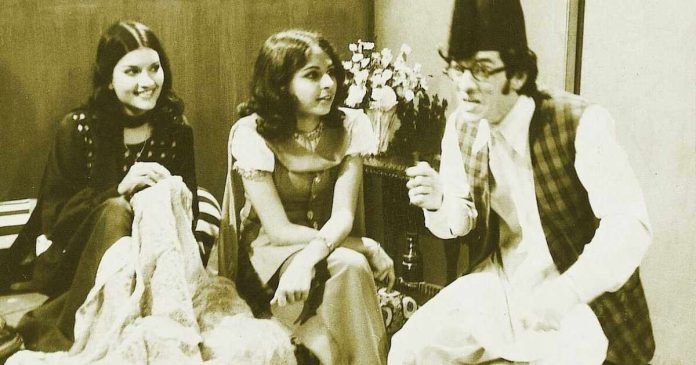
Despite being the sole player in the field, PTV did not settle for mediocrity. Instead, it became a breeding ground for actors, writers, directors, musicians, and intellectuals who would go on to define Pakistani popular culture. Even today, the dramas that aired on PTV back in the day are considered the benchmark, like Tanhaiyan, Alpha Brave Charlie, Khuda Ki Basti, Ankahi, Ainak Wala Jin, Dhoop Kinare and Sona Chandi.
Its programming spanned entertainment, news, sports, children’s content, and infotainment. There was an unmistakable intellectual seriousness to its output. The dramas were not merely for escapism; they shed light on real life, and news was not spectacle but rather analysis.
PTV evolved into a credible source of current affairs and a realistic commentator on both national and global socio-political issues.
This was the PTV of the 20th century, and it is this version that audiences still mourn.
When Competition Arrived
The dawn of the 21st century brought with it a seismic shift.
In 2000, Indus TV became Pakistan’s first private broadcasting network. Within a decade, dozens of private channels entered the electronic media landscape. For the first time, PTV faced competition.
Instead of redefining itself with clarity, PTV drifted. It shifted away from its academic and intellectual programming toward a more commercial approach, but as a state-owned broadcaster, it could never fully embrace commercial logic. The result, you may ask? Well, an identity crisis.
PTV flirted with its traditional ethos while simultaneously trying to mimic private channels, and failed at both.
The channel that once set standards began chasing trends it could not sustain.
Bureaucracy, Politics, and Paralysis
Many industry veterans argue that PTV’s decline has little to do with resources and everything to do with governance.
Actor Javed Sheikh has repeatedly dismissed the notion that PTV lacks technical capacity. “PTV has everything,” he told The Express Tribune. “You have equipment, you have sources. Rawalpindi, Karachi, Quetta, Peshawar, every centre has infrastructure. Like they used to make dramas before, they can do it again.”
For Sheikh, the problem is leadership and intent. He believes the absence of a strong cultural vision at the top has hollowed out the institution. “A cultural minister should come, a new MD should come, a chairman should come, someone who changes the whole scenario,” he said. “It’s very simple.”
Actor Behroze Sabzwari offered a more haunting metaphor. “PTV has been made to sit at home like an old man,” he said. “It has been destroyed by bureaucracy.” Recalling visits to PTV Karachi, he described empty corridors and unused studios. “The infrastructure is number one, but unused.”
Ironically, much of today’s private television industry is run by people trained at PTV itself.
Heads of departments across private channels are often former PTV professionals, a reminder that the issue is not talent, but how it has been sidelined.
Another persistent argument is that good writing no longer exists. Sheikh strongly rejects this. “The dramas being watched today on private channels and digital platforms are getting billions of views,” he said. “So where are the writers coming from?”
He pointed to projects like Jama Taqseem, Paamal, Case No. 9, and the work of director Nadeem Baig as proof that audiences still respond to strong narratives. “If society didn’t accept these stories, they would flop. But they’re popular. That’s the rating.”
At the same time, financial realities cannot be ignored. Today’s prime-time dramas often cost five to ten crores. “PTV has to raise its budget,” Sheikh admitted. “Big actors and writers won’t come if they aren’t paid.” Yet, he maintained that PTV still possesses resources that private channels can only dream of.
Actor-director Yasir Hussain, however, cautions against romanticising the past. “If we only remember the dramas of the 70s, 80s, and 90s, then we should just run them and call it Nostalgia TV,” he remarked at a recent event.
Hussain argues that PTV still enjoys the widest terrestrial reach in the country, but fails to use it meaningfully. “The drama slot with the biggest audience is not being treated seriously,” he said. “TRP can be generated anywhere.”
He also questioned why quality lags despite ideal facilities. “We shoot on location, in heat, without facilities. PTV has air-conditioned studios. They can make dramas twenty times better.”
What Does PTV Have To Say?
From within the organisation, PTV officials argue that critics overlook the channel’s broader mandate.
PTV General Manager Amjad Shah has repeatedly emphasised that PTV is not merely an entertainment outlet. “PTV is a national channel. Our responsibilities are different,” he said.
He pointed to ongoing and upcoming projects, including Babu Ki Dulhanniyan, new plays by Asghar Nadeem Syed, Ramadan transmissions, religious programming, and large-scale concerts featuring Rahat Fateh Ali Khan, Ali Zafar, and Atif Aslam.
“We are working according to today’s trends, while staying connected to our traditions,” Shah said.
At the same time, he acknowledged how commercial pressures have reshaped creative decision-making. “Earlier, directors had complete freedom. Now, casting and glamour are dictated by sales. That’s where creativity suffers.”
For actor and writer Bushra Ansari, the loss is deeply personal. “PTV has a treasure of music,” she said. “It hurts that it couldn’t be used properly.” Theme songs, original compositions, and background scores were once integral to storytelling. Today, they are an afterthought.
Actor Hiba Bukhari offered a pragmatic counterpoint. “Producers invest in what sells,” she said. “Only 20% of audiences want something different.” Yet even she acknowledged that unconventional projects like Kabli Pulao on Green Entertainment and Case No. 9 prove that risk-taking can still pay off.
PTV’s fall from grace is not an isolated tragedy. It mirrors the broader story of state-owned enterprises in Pakistan: politicised leadership, compromised merit, and institutions turned into mouthpieces rather than public services.
As political interference grew, PTV’s credibility as a news source eroded. Biased reporting and selective narratives pushed audiences toward private channels for fact-based information.
Once a source of reliable news and thoughtful analysis, PTV is now widely perceived as a government spokesperson.
The result has been not just falling viewership, but a loss of trust built over decades.
Can PTV Rise Again?
People still recall the golden era of PTV because its standards have yet to be matched, even by commercially driven private media. The tragedy is not that PTV fell, but that it seems unwilling or unable to rise.
The infrastructure exists, and so does the talent. The audience, contrary to popular belief, still exists. What remains missing is vision, autonomy, and the courage to treat culture as more than a line item or a political tool.
Stay tuned to Brandsynario for latest news and updates