
















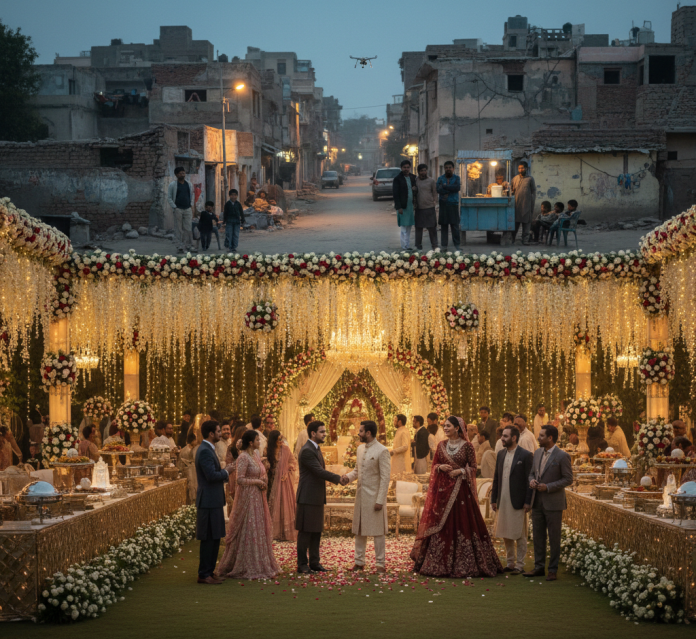

The winter of 2026 has left a haunting image in Pakistan’s collective memory. In Lahore, the orange glow of a multi-million rupee wedding marquee shines bright. Meanwhile, in Karachi, the ruins of Gul Plaza still smoulder. Dozens of families are now scouring the debris of a preventable fire tragedy. This disaster claimed 26 lives.
At the same time, the political elite celebrate the “wedding of the year.” These festivities feature international designers and imported flowers. The contrast is a stark reminder of a deep national divide.
This dissonance raises a painful question: How can a country on the brink of economic collapse, unable to afford basic fire safety audits for its commercial hubs, remain home to one of the most recession-proof wedding industries in the world?
The “Recession-Proof” Spectacle
Pakistan’s wedding culture has evolved into a high-stakes performance that seems entirely detached from the country’s GDP. Despite a staggering inflation rate that has pushed the middle class toward the poverty line, the “Wedding Industrial Complex” continues to thrive.
Research into the 2025-2026 winter season reveals that the wedding industry in Karachi alone generated an estimated Rs33 billion in revenue, according to industry representatives and market estimates. This isn’t just a celebration; it is a parallel economy. While the formal economy gasps for breath, the wedding sector supports a massive informal network of 80 to 100 direct service providers, ranging from caterers to florists, for every single event.
The Psychology of Social Prestige
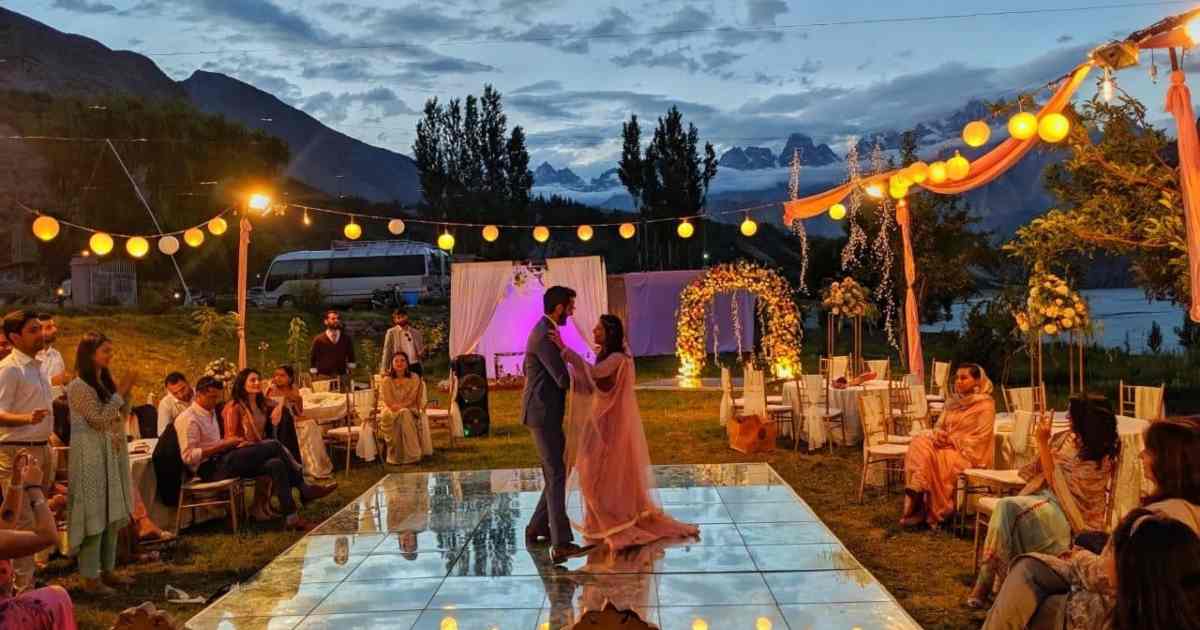
The reasons for this unchecked spending are deeply rooted in socio-economic insecurity. In a society where public institutions, schools, hospitals, and safety regulations are failing, the “Wedding” has become the primary way for a family to assert its social standing. This is “conspicuous consumption” at its peak.
Research shows that for middle and upper-middle-class families, an average wedding now costs between Rs 10 million and Rs 20 million. For a country with an average annual household income significantly under $4,000, this represents an astronomical expenditure. Families often drain entire life savings or enter high-interest debt traps to fund a single week of festivities, driven by the psychological pressure to signal status to a community that measures worth by the guest list and the menu.
A Comparative Look at Costs
To understand the scale of this extravagance, one must look at the direct comparison between modern luxury spending and a sustainable model.
The Wardrobe and Designer Culture
High-cost bridal ensembles from top-tier designers now frequently cross the Rs. 2 million mark. One designer outfit can cost over Rs2 million, an amount that could support a low-income family for years. Despite this, such dresses are often worn for only six hours.
The recent trend of wearing international luxury brands has sparked a viral debate. By choosing Indian designer labels over local craftsmanship, the elite are further draining the country’s precious foreign exchange.
The Multi-Event Marathon
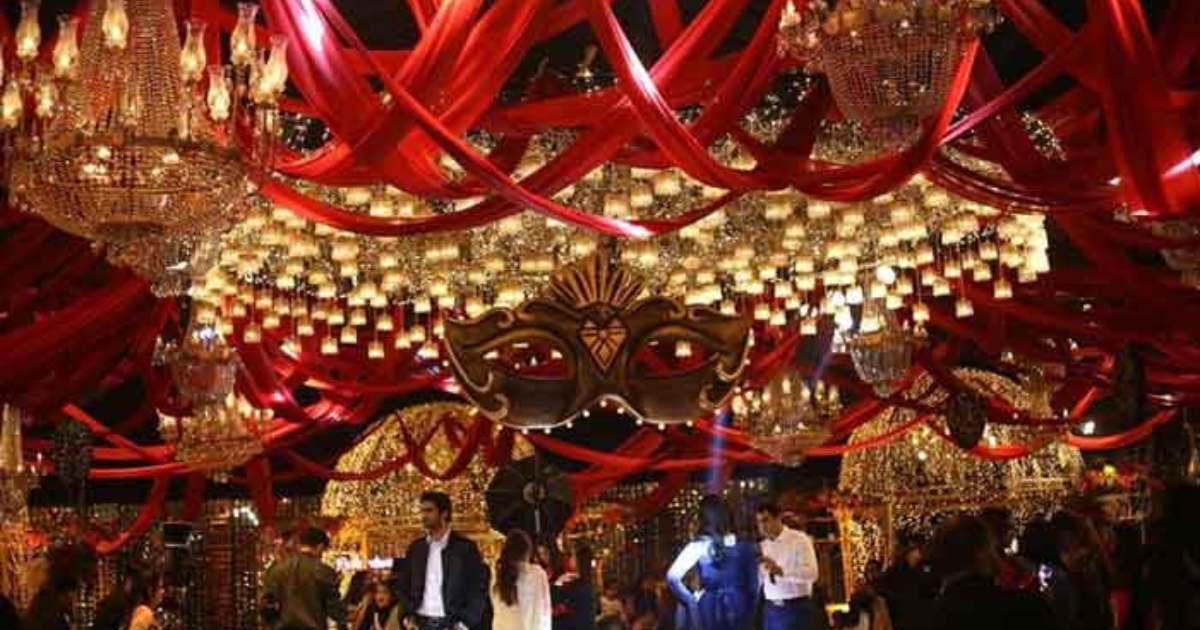
Today’s “lavish” wedding is no longer a three-day affair; it is a gruelling marathon of production. The fatigue of hosting Dholkis, Nikkah brunches, Qawwali nights, and elaborate Bridal Showers has turned weddings into theatrical events. These extra events often add an additional 40% to 50% to the total wedding budget.
Extravagant Menus and Food Waste
Despite “one-dish” regulations, elite menus have shifted toward wasteful indulgence. Per-head costs at top-tier venues can now reach Rs15,000. This extravagance occurs even as food inflation remains a critical issue, with the price of basic staples like wheat flour rising significantly during the peak wedding season due to sudden surges in demand.
Safety vs. Splendour: The Moral Dissonance
The tragedy at Gul Plaza on January 17, 2026, is a direct indictment of the state’s priorities. The fire resulted in an estimated Rs100 billion in economic losses and destroyed over 1,000 shops. Investigation reports highlighted that the building, which saw a daily footfall of 100,000 people, relied on just 144 fire extinguishers, one for every ten shops.
There is a profound moral dissonance in a nation where the elite can afford millions for a single night’s decor, but the state cannot fund the fire stations and safety audits required to protect its commercial hubs. Safety is treated as a “financial burden,” while wedding splendour is viewed as an essential investment in social capital.
A Path Toward Austerity
Indeed, the expenditure of a modern elite wedding is staggering when viewed through the lens of national tragedy. On the one hand, a high-profile wedding often involves renting private farmhouses for millions, frequently bypassing local taxes. On the other hand, a ‘Controlled Model’ of celebration, focused on simplicity, could redirect these vast funds toward sustainable infrastructure.
Ultimately, choosing austerity over extravagance is not just a personal choice; rather, it is a necessary step toward addressing the systemic neglect seen in disasters like the Gul Plaza fire.
By combining the Nikkah and Walima and strictly adhering to a two-dish menu, a family can save up to 70% of their total budget. If the billions currently spent on temporary lighting and imported flowers were instead taxed or voluntarily redirected, they could fund the very fire hydrants and emergency response systems that were missing at Gul Plaza.
Reclaiming the Sanctity of the Union
The juxtaposition of the Gul Plaza fire and the extravagant political wedding is a wake-up call for Pakistan. We cannot continue to burn our capital on temporary lights while our citizens burn in neglected buildings.
It is time to shift our definition of a “successful” wedding from the number of dishes on the menu to the sustainability of the future it builds. A wedding should be a foundation for a new life, not a funeral for a family’s financial security or a nation’s conscience.
Stay tuned to Brandsynario for the latest news and updates