
















What Is a Duopoly?
A duopoly is when two companies control the majority of a market. When a duopoly exists, these companies have notable influence over pricing, production, and strategic decisions. Unlike monopolies, duopolies involve competition. However, this competition only exists between the two dominating parties. This structure fits in a broader category called an oligopoly, where select firms control a market.
Within a duopoly, both companies watch each other’s moves closely. A move by one brand almost always sets off one by the other. Decisions about price or output have a direct impact on the other. As a result of this, the market becomes calculated, like a game of chess.
Why Duopolies Form in the First Place
Duopolies tend to form in industries that have high barriers to entry. Barriers range from massive startup costs to deep brand loyalty. Newer companies face hurdles in competing at the same scale.
In a matter of time, weaker competitors tend to quietly exit the market. The strongest two refuse to budge from their pedestals. The dominance tends to be split, whether evenly or not. We see this pattern being repeated across industries, from tech to consumer goods.

Real-World Duopoly Examples
Everyday life is shaped by industries that run on a duopoly structure:
-
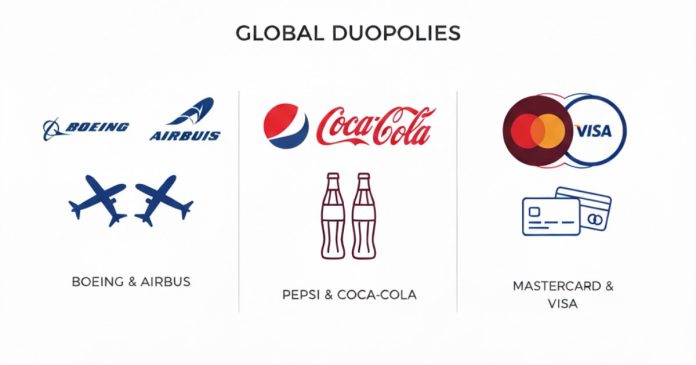
Coca-Cola and Pepsi dominate the global soft drink industry. They compete through branding and marketing rather than price cuts.
-
Apple iOS and Google Android control over 90% of the smartphone operating system market. App developers tend to prioritise these two platforms.
-
Visa and Mastercard process the majority of global electronic payments, leaving merchants and consumers with limited options.
-
Boeing and Airbus lead the commercial aircraft manufacturing industry, influencing pricing and accessibility.
The examples demonstrate how duopolies exist even in the most unlikely of markets.
How Duopoly Competition Works
Duopolies do not compete as open markets. Economists are tasked with analysing duopolies through theoretical models to understand how firms behave.
Cournot competition focuses on output decisions. Companies choose how much to produce after considering how much their rival will supply. This process leads to a balance where neither firm wants to change its output.
Bertrand competition focuses on price. Firms assume their rivals’ prices will remain fixed and compete by undercutting them. This strategy pushes prices down, but firms avoid pricing below production costs.
Both models demonstrate how duopolies encourage caution. They do not behave like monopolies and are focused on creating strategic outcomes and avoiding major risks as each move triggers a response.
What Duopolies Mean for Consumers and Policy
Duopolies influence market dynamics, creating mixed outcomes for buyers.
On one hand, rivalry fuels innovation. Brands push for upgrades, focus on improvement, and invest heavily in marketing in order to acquire and maintain a loyal customer base. Smartphones, payment security and beverages have advanced due to duopoly pressure.
On the other, it has its shortcomings. With only two dominant providers, choices are limited. This keeps prices high with fewer alternatives. Switching between only two brands tends to make consumers feel like they have less agency over their buying behaviour.
Ultimately, duopolies slow disruption, with smaller challengers struggling to survive the period needed to scale.

Why Regulators Keep a Close Eye on Duopolies
For government bodies, it is essential to monitor duopolies to prevent anti-competitive behaviour. If two firms end up coordinating instead of competing, buyers end up getting the short end of the stick.
Regulation involves monitoring pricing practices, data control, and establishing exclusivity agreements. Certain industries experience direct involvement of regulators, where they end up having to force transparency or permit new entrants to be added.
Yet breaking duopolies is no easy task. Issues of capital and infrastructure shield the dominant players.
Is it Possible to Break a Duopoly?
In the world of business, anything is possible. Still, change takes its sweet time. Technology poses as the biggest disruptor. For cable duopolies, streaming platforms have been driving them to obsolescence. With the rise of fintech apps, traditional payment networks have been heavily threatened.
Regulation is of the essence. Anti-trust enforcement tends to unravel the market, and consumer behaviour is constantly evolving. Demand shifts force brands into choosing between adapting or risk losing relevance.
Generally, duopolies tend to evolve rather than disappear. While a brand may have a tough period, it rapidly makes up for it.
Why Understanding Duopolies Matters
Duopolies have shaped modern capitalism. They choose what’s put on shelves, how much is paid, and what rate innovation moves at. Through recognising duopoly structures, consumers get a chance to make informed decisions and perceive strategic moves.
Technology and policy stand in opposition to duopolistic power. In an evolving market, new entrants and regulatory pressure can erode concentrated markets. However, this can only take place gradually. It is vital for consumers, policymakers and entrepreneurs to understand why certain choices are limited.
When two brands rule, every choice matters more than it seems.
Stay tuned to Brandsynario for latest news and updates