














In a market as bustling as Pakistan, originality should be the strongest currency. For some reason, many brands are choosing to blend in instead.
We see it everywhere, whether it’s packaging or campaigns, brand imitation is shaping local marketing. Inspiration is common and understandable, but the scale and repetition of these similarities raise some alarm bells. Casual consumers are noticing, and creators are calling it out, and a conversation needs to be held on why this keeps happening.
Reggia vs Young’s
The most striking example in recent memory comes from the food industry. It all started when Young’s posted its Big Elbow Macaroni creatives on March 26, with a visual tone that was carefully designed in line with their branding style.
Just days later, on April 5, Reggia Pasta posted its campaign for elbow macaroni, and the resemblance was uncanny. The background, lighting, composition, colour, and even the angle at which the packet was tilted, all of it was identical.

This wasn’t a one-off instance. On March 20, Young’s posted their ad for Orla Cooking Oil, an image of the product placed beside a pan. Once again, the entire image was duplicated by Reggia Pasta, with the only difference being the product image and the food in the pan being edited into a pasta dish. Other than that, it was all the same. On March 26, Young’s posted their ad for shell macaroni, and once again, days later, Reggia Pasta posted the same image for their farfalle, and this time, even the typography and slogan were the same. This keeps on happening, as even on April 6, Reggia Pasta posted the same image as one Young’s posted on March 26, with the same elements, composition, typography, and structure.

Why This Isn’t Just Inspiration
Marketing trends are definitely a thing, but it’s easy to tell when brand imitation is taking place. When visuals cannot be told apart, it stops being inspiration and starts becoming replication.
This is a major issue for brands, since this can be confusing for customers and affect brand recall. Consumers have a hard time telling the two brands apart, and value drops significantly for both. In marketing, brand identity is the foundation, and brand imitation jeopardises exactly that. In a saturated market, it is important to maintain uniqueness to stay relevant. Along with this, it is a blow to the efforts of the original creators behind an ad, bringing in questions of ethical boundaries in marketing.

Sunsilk vs Meclay London
The beauty industry has also seen its fair share of brand imitation. One recent example being discussed by consumers is that of Sunsilk and Meclay London. Sunsilk is known for its strong visual identity that can be recognised at a single glance.
When Meclay first appeared on the scene, many thought they were Sunsilk campaign. The circular pink background with a bright halo, the bottle colours, and hair flip poses were all reminiscent of Sunsilk. Even the font of the brand was the same, which is why many ended up confusing the two brands, and some even thought of Meclay as a product of Sunsilk.

Maya Ali vs Faiza Saqlain
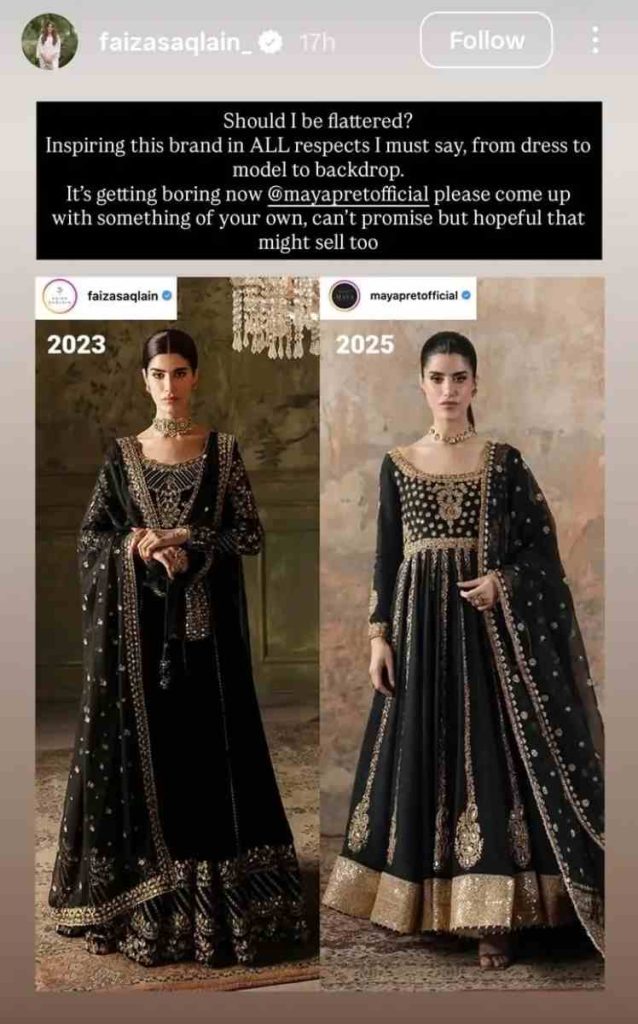
The conversation extends beyond FMCG into the local fashion industry. Designer Faiza Saqlain openly called out Maya Ali’s brand, MAYA Prêt-À-Porter, for copying her work.
The designer shared side-by-side comparisons of overlapping designs, embellishments, and even shoot backdrops. This included a bridal ensemble from her 2021 line, as well as an ombre sari. Her scathing post asked, “Should I be flattered?” and challenged MAYA Prêt-À-Porter to create original designs. She also reshared posts from fans and colleagues that discussed the similarities and expressed disappointment over the blatant copying.

JazzCash vs MasterCard
JazzCash’s recent rebrand needs to be mentioned in this discussion as well. The brand has shifted to a more icon-driven logo, which many drew parallels with MasterCard’s iconic overlapping circles design.
This case brings out a different angle in this discourse. Designers were disappointed by the lack of originality, but users seemed to appreciate the usability. The average consumer is more focused on ease of transactions than design originality, which shows that the effects of brand imitation don’t apply to all industries.

Mondo Coffee Bar
When Mondo Coffee Bar launched in Karachi, everyone was buzzing. In a city with countless coffee shops, it felt like something new. The luxury ambience and can packaging felt unique, and consumers flocked to get a table. However, legal issues soon doused the excitement as Mondo Coffee bar faced allegations of copying the identity of Thailand’s Mondo Espresso & Tea Bar.
The Thai brand posted on Instagram calling out the Pakistani Mondo, and a consumer court issued a notice in October 2025. The complainant sought Rs5 million in damages under consumer protection laws, and the incident tainted the image of the new coffee. Additionally, the brand design for Mondo Pakistan now features an updated logo that still features the stylistic elements of the original but has its own spin on it.


Market Pressures and Brand Value
Pakistan’s competitive market is one of the main reasons behind this repeated occurrence. Margins are limited, and rivalry is intense. Brands tend to go for risk aversion, taking up proven formulas instead of experimenting with original ideas.
Brand imitation is ultimately a shortcut. Brands get to launch faster in a market based on speed, and they don’t have to heavily invest in something that may or may not work out. By working with existing familiarity, success seems almost guaranteed.
Playing it safe does come at a cost. This approach weakens brand equity, and differentiation is hard to find. When consumers struggle to form associations, loyalty cannot be built. In an industry that thrives on creativity and human output, this situation can dampen spirits and discourage original thinking.
What Defines Pakistani Marketing Today?
This conversation is part of a broader concern: What defines Pakistani marketing?
Most countries tend to have their own style. The United States has a competitive and direct approach, whereas China draws on principles of collectivism. Some countries prefer a minimalist approach, while some prefer a more over-the-top approach.
Figuring out what defines Pakistani marketing is a worthwhile conversation. When the marketing industry overly relies on reliability and repetition, it can limit growth. Uniqueness forms the foundation of brand power; Pakistani marketers must understand this principle.
The Way Forward
This discussion doesn’t completely seek to eliminate inspiration. Brands must draw a line where they adapt and reshape ideas to fit their unique identity.
Brands need to invest in original narratives and distinct design systems. With authentic messaging, they can develop loyal connections with their audiences. Taking a step away from brand imitation will elevate brands in the long-term and help them truly stand out.
Stay tuned to Brandsynario for latest news and updates