
















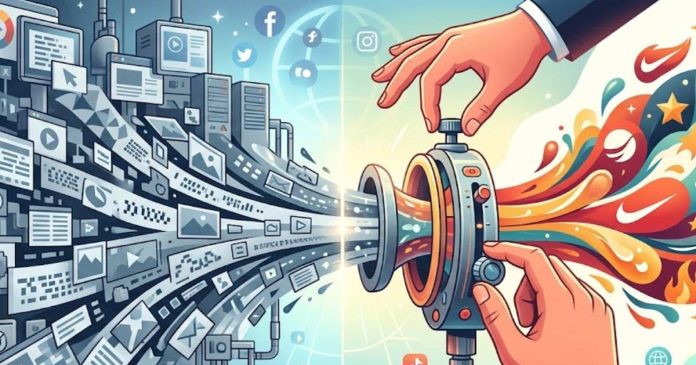

You just finished your coffee. In those ten minutes, your AI tool churned out 1,000 ad variations. Impressive, right? Now, here’s the cold truth: Your biggest competitor just did the exact same thing using the exact same prompt. If everyone is using the same ‘magic’ button, is anyone actually winning, or are we just creating a sea of digital noise that all sounds the same?
The real challenge in 2026 isn’t just producing content; it is maintaining a distinct identity in a digital world flooded with AI-standard prose. High-growth brands are no longer asking if they should use AI. Instead, they are figuring out how to brand-train these tools to ensure every TikTok, email, and product description feels authentic.
The Content Explosion: Why We Needed a Multiplier
1. The Content Explosion & Human Burnout
- Production Pressure: Nearly 33% of business owners and marketers reported doubling their content production in just the past year.
- Resource Constraints: A lack of resources is cited by 54% of B2B marketers as their primary challenge in meeting content demands.
- The Creative Toll: About 36% of professionals admit they have sacrificed creativity or originality to keep up with output goals.
- Burnout Rates: Roughly 21% of marketers report feeling frequently burned out, specifically due to the nonstop demands of content production.
2. AI as a Scale Multiplier
- 75% Output Boost: Teams utilising AI for both content creation and automation produce 75% more content per week than those that don’t.
- Time Reclaimed: Marketers using AI report saving an average of 14 hours per week, effectively gaining nearly two full workdays for higher-level strategy.
- Cost Efficiency: Companies excelling at lead nurturing (often supported by AI) generate 50% more sales-ready leads at a 33% lower cost.
3. The Sea of Sameness Paradox
- Algorithmic Erasure: Because AI models optimise for the most statistically probable (or average) answer, brands that rely on generic prompts end up sounding identical to every competitor.
- Consumer Detection: Research shows consumers can often intuitively identify AI-generated ads and frequently rate them as more annoying, boring, or confusing than human-produced content.
- Trust Inflection Point: AI-generated messaging that feels soulless can erode brand trust, as audiences increasingly value authenticity and lived human experience.
- The Differentiation Trap: When every brand uses the same foundational models (like GPT) without human refinement, their unique brand voice is sanded down in pursuit of algorithmic perfection.
How AI Currently Drives Content Scale
To understand how to protect a brand, we first have to look at how AI is actually doing the work. Most modern marketing departments break AI usage into three specific functional areas:
1. Multimodal Generation
Content is no longer just text. Brands use a suite of tools to handle different mediums:
- Copywriting: Tools like ChatGPT and specialized marketing platforms generate blog posts, captions, and ad headlines in seconds.
- Visual Design: AI image generators create custom photography and illustrations without the need for expensive photoshoots for every single social post.
- Video Production: AI video tools allow brands to create short-form video content from simple text prompts, which is essential for staying relevant on Reels and TikTok.
2. Dynamic Creative Optimisation (DCO)
- Hyper-Personalisation: AI analyses data like weather, location, and browsing history to instantly swap headlines, images, and CTAs. For example, localised ad copy has shown an 87% increase in click-through rates for certain demographics.
- Performance Gains: Studies indicate that AI-driven DCO can boost campaign performance by at least 30%, with some brands reporting a 17% reduction in cost per action and a 32% increase in return on ad spend.
3. Instant Localisation
Global brands previously spent months translating and culturally adapting campaigns. Now, AI allows for near-instant localisation. This isn’t just about translating words; it is about adapting cultural references and visual cues so the brand feels local in every market it enters.
The Identity Crisis: The Risks of Over-Automation
The biggest risk of scaling with AI is losing the human touch. If a brand relies too heavily on raw AI output, several things start to go wrong:
- Generic Tone: AI tends to default to a helpful assistant tone that is polite but boring. It lacks the wit, edge, or specific quirks that make a brand memorable.
- Inconsistent Messaging: Without strict oversight, AI might emphasise features that don’t align with the brand’s core values or mission.
- The AI Voice Fatigue: Consumers are becoming very good at spotting AI-generated content. If they feel a brand isn’t putting in the effort to talk to them like a human, they lose trust.
So, Who is Doing it Right?
Several global giants have already set the blueprint for using AI without losing their essence.
Coca-Cola: The Power of Participation
Coca-Cola didn’t just use AI to make ads; they used it to let their fans make ads. Their Create Real Magic campaign allowed users to play with iconic brand assets using AI.
- The Result: They generated massive amounts of content while keeping the visual style strictly within the Coke universe.
- The Lesson: Give the AI the ingredients of your brand and let it cook, but don’t let it change the recipe.
Netflix: Personalisation as Identity
Netflix uses AI to change the thumbnails you see on your home screen. If you like romance, you might see a couple on the cover of a movie. If you like action, you might see an explosion.
- The Result: This scale doesn’t feel robotic; it feels like the platform knows you.
- The Lesson: Scaling identity means scaling the relationship you have with each customer.
Nike: Data-Driven Storytelling
Nike uses AI to analyze how athletes move and what they need. They then use these insights to generate personalised training content and product recommendations.
- The Result: The content is always high-performance and inspirational, fitting the Just Do It spirit perfectly.
- The Lesson: When your automation is built on deep consumer insights, the resulting content doesn’t feel like a “bot,” it feels like a brand that listens.
How to Build a ‘Non-Robot’ Brand
How can your brand scale without becoming a robot? It comes down to four strategic moves:
1. Train Your Own Private Models
Smart brands don’t just use public AI. They feed their own brand guidelines, pass down successful campaigns, and specific voice documents into the system. This teaches the AI to use the specific vocabulary and tone that belongs only to that brand.
2. Human + AI Collaboration (The 80/20 Rule)
The most successful workflow is often 80% AI and 20% human. The AI does the heavy lifting of drafting and versioning. Then, a human editor steps in to add the “soul,” the humour, the cultural nuance, and the final brand check.
3. Develop Prompt Engineering as a Core Skill
A brand’s identity is now defined by the quality of its prompts. Marketers must become experts at telling AI exactly how to speak. Instead of saying write an ad for shoes, they say write an ad for shoes in the style of a 1990s street photographer, using energetic and rebellious language.
4. Build Digital Guardrails
Set hard rules for your AI. List forbidden words that don’t fit your brand. Define the exact colour palettes the AI is allowed to use. These constraints actually make the AI more creative within the boundaries of your identity.
Pro-Tip: The “Human Signature” check. Before hitting publish on AI copy, ask: “Could my competitor have posted this exact same caption?” If the answer is yes, delete it and add a brand-specific quirk.
The Local Context: Why This Matters for Pakistan
In Pakistan, the shift toward AI content is especially critical. For local brands and startups operating on tight budgets, AI isn’t just a fun tool; it is a survival mechanism.
- FMCG and E-commerce: Companies like Daraz are using AI to manage thousands of product listings. For these brands, AI allows them to compete with global giants by maintaining a high frequency of communication without a massive headcount.
- Language and Culture: The next frontier for Pakistani brands is Roman Urdu and regional language AI. Scaling content that speaks to the local heart in the local tongue is where the biggest wins will happen in the next two years.
- Efficiency: AI is our scale multiplier. It allows a small team in Karachi to produce content that looks like it came from a global agency in New York.
The Future is Brand-Centric AI
The era of AI for the sake of AI is over. We have entered the era of Strategic AI. Scaling content is no longer a technical challenge; it is a creative one. The brands that will dominate the market in 2026 are those that treat AI as a highly talented but raw intern who needs constant, clear, and brand-focused direction.
By combining the speed of machine learning with the irreplaceable spark of human creativity, you can ensure that as your content volume grows, your brand identity only gets stronger. The goal isn’t just to be everywhere, it’s to be yourself, everywhere.
Stay tuned to Brandsynario Tech for the latest news and updates.


 Join a Channel
 Brandsynario
 Veryfilmi