








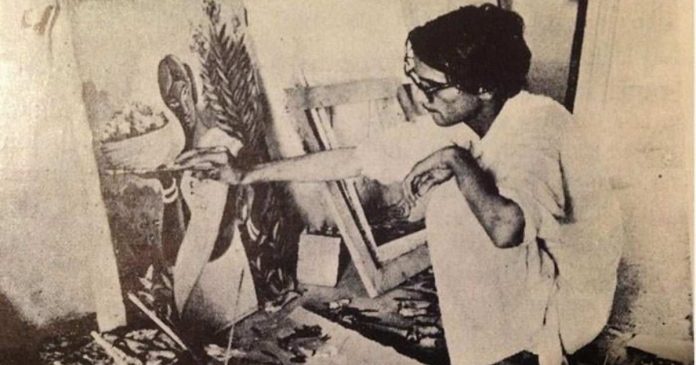
On June 12, 1976, a bomb blast rocked the Lahore Punjab Arts Council. Smoke filled the gallery. Shattered glass covered the floor. Outside, angry mobs cheered and demanded the artist’s death. Their target was Syed Sadequain Ahmed Naqvi. He carried no weapons. He used only a paintbrush, dark ink, and an uncompromising vision of human truth. This dramatic confrontation defines Sadequain’s life. He was the ultimate South Asian maverick. He turned the canvas into a political and spiritual battleground.
Sadequain was a walking paradox. He lived like a penniless mystic, yet his art commanded global attention. He painted the painful realities of society, yet he survived oppressive military regimes. Today, his legacy crosses borders. It connects pre-Partition India, post-war Europe, and the Middle East. Sadequain blended ancient calligraphic traditions with radical modernism. By doing so, he forever changed South Asian art.
Key Takeaways
- Born in India (1930), Sadequain brought his deep training in traditional Arabic calligraphy to Pakistan after the 1947 Partition.
- He won international acclaim in Paris during the 1960s, famously illustrating Albert Camus’s novel L’Étranger.
- He used the jagged, thorny lines of the desert cactus to symbolise human survival and resilience under political oppression.
- Right-wing groups bombed his Lahore exhibition over his raw, figurative art, but the attack failed to silence him or his progressive supporters.
- He cleverly bypassed strict military censorship under General Zia by shifting from figures to monumental, radical Quranic calligraphy.
- He lived like a penniless mystic, refused to sell his work to elites, and gifted his massive public murals directly to the citizens of Pakistan.
The Cross-Border Roots of a Radical Genius
Sadequain’s early life shaped his radical vision. His journey across shifting borders anchored his deep understanding of language and line.
- The Calligraphic Subconscious: Sadequain was born in Amroha, India, in 1930. He grew up in a cultured Shia family. Calligraphy was a daily spiritual practice for him. Before the 1947 Partition, he worked as a copyist for All India Radio in Delhi. This training etched the geometric flow of Arabic text into his mind.
- The Trauma of Migration: The mass displacement of Partition forced Sadequain to move to Pakistan. This cross-border uprooting filled his early work with themes of loss, identity, and reconstruction.
- The Global Breakthrough: His genius quickly broke regional boundaries. Sadequain travelled to Paris and won the prestigious Biennale Laureate in 1961. He spent years in Europe and captivated Western critics. He even illustrated a luxury edition of Albert Camus’s famous novel, L’Étranger. This international exposure turned him into a global icon of modernism.
The Metaphor of the Cactus: Calligraphy Meets the Desert
In 1957, Sadequain suffered a severe nervous breakdown. He retreated to the dry, sun-bleached seaside of Gadani, Pakistan, to heal. Here, he discovered his ultimate artistic muse: the wild desert cactus.
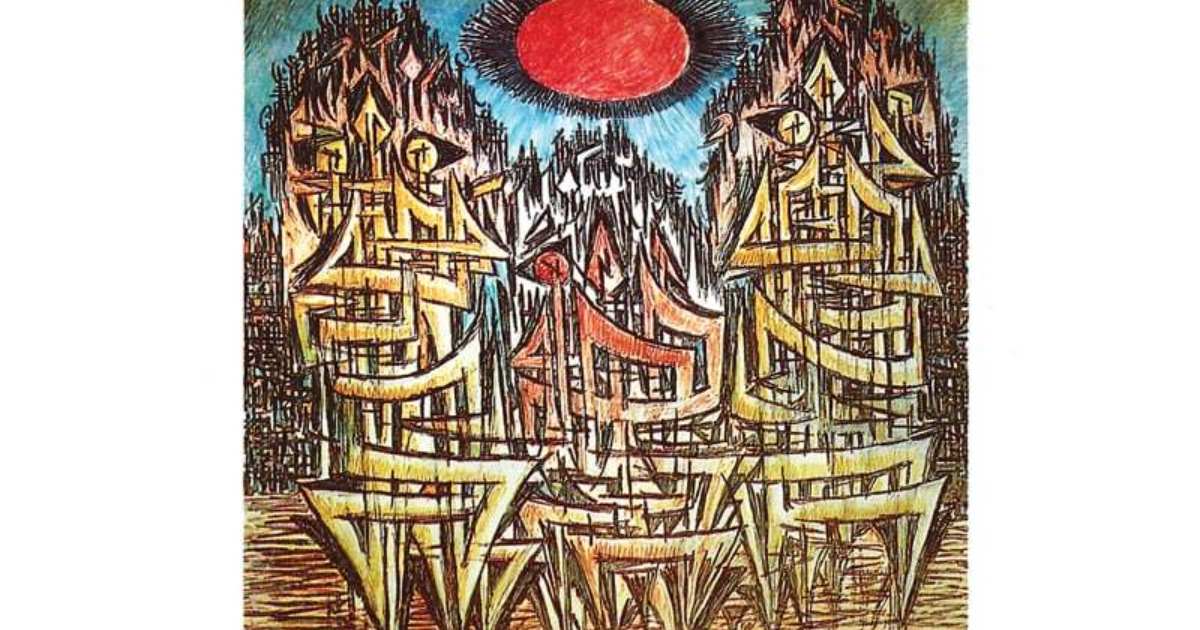
Sadequain saw the cactus as a profound symbol of the human condition. The gnarled, thorny limbs reminded him of the sharp strokes of Kufic calligraphy. He realised that the cactus survives in harsh environments by growing protective, jagged spikes.
This realisation created the famous Sadequain line. His human figures became elongated, thin, and tangled with thorns. This unique style symbolised human resilience under political oppression. He used these sharp, bleeding lines to show that humanity can endure the most hostile environments.
Art Under Fire: The Explosive Lahore Exhibition of 1976
By the mid-1970s, Pakistan’s political landscape shifted toward religious populism. Sadequain’s art targeted social corruption, making him a prime target for right-wing political factions.
In May 1976, Sadequain unveiled forty monumental paintings at the Punjab Arts Council. Religious student groups, specifically the Islami Jamiat-i-Talaba, immediately attacked the event. They falsely labelled his raw, exposed human figures as obscene and un-Islamic.
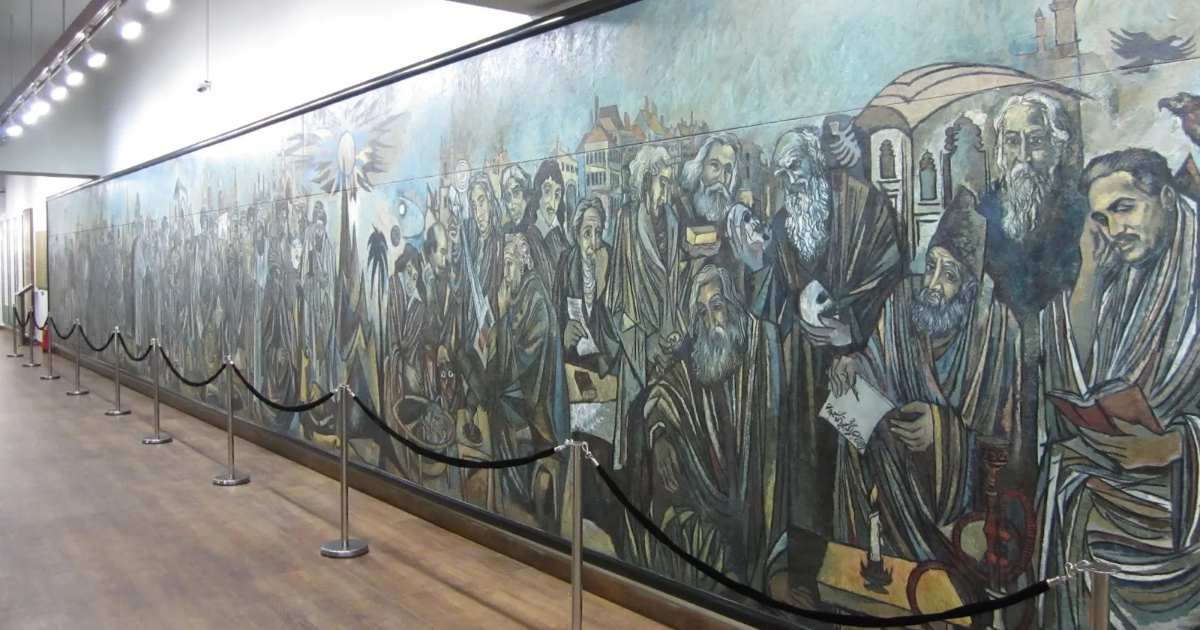
The tense standoff ended with a terrifying bomb blast inside the gallery. However, the violence backfired completely. The attack did not scare people away. Instead, it drew thousands of curious citizens to the gallery. Progressive intellectuals, including the legendary poet Faiz Ahmed Faiz, rushed to Sadequain’s defence. Faiz dryly noted that if the exhibition was supposed to be scandalous, it was highly disappointing. Sadequain remained completely unbothered. He dismissed his attackers as small, insignificant pests.
The Grand Paradox: Navigating Power and Dictatorship
Sadequain easily navigated treacherous political waters. He survived shifting state ideologies without losing his creative soul.
| Regime Era | Political Ideology | Sadequain’s Artistic Response |
| Zulfikar Ali Bhutto (1970s) | Populist Islamic Socialism | He painted massive public murals celebrating human labour, workers, and peasant struggles. |
| General Zia-ul-Haq (Late 1970s–1980s) | Conservative Military Islamisation | He shifted his focus to monumental Quranic calligraphy, revolutionising the art form to bypass censorship. |
This shift to Quranic calligraphy was an act of pure genius. General Zia’s military regime banned figurative art. In response, Sadequain used holy texts to create sweeping, abstract landscapes. He weaponised calligraphy to preserve his artistic freedom. The military dictatorship eagerly celebrated his religious work. They failed to see that Sadequain still painted with the same rebellious, untamed lines.
The Bohemian Mystic and His Lasting Gift
Sadequain lived his life as a malang, a wandering, holy eccentric. He rejected material wealth and never sold his paintings to elite galleries or rich collectors. Instead, he painted massive public murals and gifted them directly to the common people.
He worked in a state of pure creative frenzy, fueled by sweet tea and cigarettes. He left his monumental masterpieces on the ceilings and walls of major public spaces. You can still see his work today at Karachi’s Frere Hall, the Mangla Dam, and the State Bank of Pakistan. He believed art belonged in the streets, not in private living rooms. He frequently painted himself as a headless figure, symbolising a martyr who sacrifices everything for absolute truth.
Syed Sadequain passed away in 1987 while working on his final, unfinished mural at Frere Hall, titled Arz-o-Samawat (The Earth and the Heavens). He remains the ultimate maverick of South Asian art because his work refused to respect borders. He fearlessly bridged the secular and the divine, the traditional and the modern. By turning ancient calligraphy into a tool for political defiance, Sadequain ensured that his untamable spirit would live forever on the walls of public consciousness.
FAQS
1. How much do Sadequain paintings cost?
Syed Sadequain Ahmed Naqvi’s work has been offered at auction multiple times, with prices up to 173,000 USD for paintings and 75,000 USD for works on paper.
2. Did Sadequain write poetry?
Yes, Sadequain was an accomplished poet. Beyond his paintings and calligraphy, he wrote thousands of rubāʿiyāt (four-line quatrains) in Urdu. His poetry speaks of his thoughts and emotions.
3. What is Sadequain’s art style?
Sadequain’s visual vocabulary fused Eastern calligraphy, particularly architectonic Kufic script, with modernist figurative forms. His most iconic motif, the cactus, was inspired by the resilient desert plants he observed in Gadani, symbolising survival, strength, and defiance.
Stay tuned to Brandsynario for latest news and updates

 Join a Channel
 Brandsynario
 Veryfilmi