
















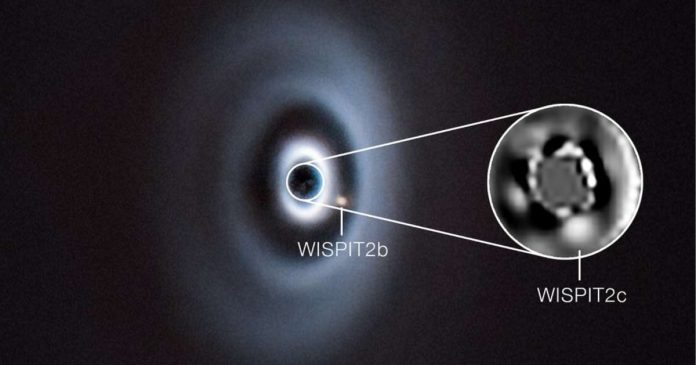

Astronomers have captured a rare look at a planetary system that shows a mirror image of our own solar system. Using the European Southern Observatory’s Very Large Telescope (VLT), researchers identified two massive exoplanets forming around the young star AF Leporis.
This discovery provides a unique cosmic time machine. It allows scientists to witness the chaotic and violent processes that shaped our celestial neighbourhood billions of years ago. By observing these distant giants, we gain a clearer understanding of how gas giants stabilise and influence the birth of a solar system.
The Architecture of a Planetary Mirror
The AF Leporis system stands out because the mirror image of our solar system’s structure closely resembles the layout of our Sun and its planets. Located 87 light-years away, this star is only 24 million years old. While that sounds ancient, it is a mere fraction of our sun’s 4.6 billion-year age. The system features two primary gas giants that occupy orbits strikingly similar to those of Jupiter and Saturn.
- AF Lep b: This planet sits in a position analogous to Saturn. It orbits far enough from the star to maintain a cold, gas-heavy atmosphere.
- AF Lep c: This outer giant mirrors the role of Jupiter in our own system. Its massive gravitational pull dictates the movement of nearby debris.
Sculpting the Debris Belts
A solar system is more than just its planets; it includes the leftovers of formation. AF Leporis contains two distinct debris belts that act as counterparts to our Asteroid Belt and Kuiper Belt. These rings of dust and ice are not static. Instead, the two newly discovered planets actively shape them.
- Gap Clearing: As the planets orbit, their gravity sweeps the path clear of smaller rocks and dust. This creates visible gaps in the disk.
- Gravitational Stability: Much like Jupiter and Saturn acted as “shepherds” for our inner planets, these exoplanets prevent debris from falling inward.
- System Longevity: This sculpting process is essential for long-term stability. It determines whether a system will eventually host smaller, rocky planets like Earth.
Advanced Imaging Technology
Identifying these planets required the use of the SPHERE instrument on the VLT. Most exoplanets are found through transit, where a planet passes in front of its star and dims the light. However, scientists found the AF Leporis planets through direct imaging. This means they captured the actual light reflecting off the planets themselves.
This method is incredibly difficult. It is like trying to see a firefly hovering next to a massive searchlight from miles away. By using high-contrast imaging, the team blocked the star’s overwhelming glare. This allowed them to measure the planets’ temperatures and atmospheric compositions directly. These details provide evidence of how gas giants grow by pulling in surrounding material.
Why This Discovery Matters
The AF Leporis system serves as a laboratory for planetary evolution. It proves that the Jupiter-Saturn configuration might be a common blueprint in the universe. Scientists now have a live example of planetary migration. They can watch as these giants shift their orbits and settle into permanent positions.
This research moves us one step closer to answering how our own home formed. By comparing AF Leporis to our history, we see the universal laws of physics in action. This discovery confirms that the same forces that built our world are currently building others across the galaxy.
Every new observation of AF Leporis refines our models of space and deepens our appreciation for the rare stability of our own solar system.
Stay tuned to Brandsynario Science for latest science and tech news and updates