













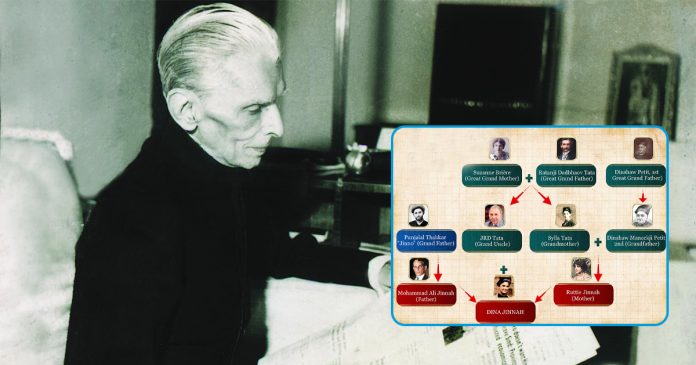

Muhammad Ali Jinnah gave the subcontinent a nation, but his own family paid a quieter price.
Recently, after his great-granddaughter came under the spotlight, we couldn’t help but wonder where Quaid-e-Azam’s family went and why we know so little about it.
Ruttie Jinnah: Jinnah’s Parsi Wife
Rattanbai Petit, known as Ruttie, was the only daughter of Sir Dinshaw Petit, a wealthy Parsi industrialist. Celebrated in Bombay society and known as the “Rose of Bombay,” she was admired for her style and confidence.
Unlike most women of her era, Ruttie was raised with an unusual degree of freedom, even the freedom to choose her own life partner.
It was at a Parsi social gathering that she first met Muhammad Ali Jinnah, a close legal associate of her father. Their meetings continued at Petit Hall, where an unlikely bond formed between the headstrong teenage girl and the austere, much older barrister.
Their relationship quickly became the subject of a scandal.
With a nearly twenty-four-year age gap and deeply entrenched religious differences, the union was deemed unthinkable by society.
When Jinnah expressed his intention to marry Ruttie, Sir Dinshaw Petit was enraged. Accusations followed, and some even claimed Jinnah had “kidnapped” his daughter.
Ruttie firmly rejected these claims, publicly declaring that it was she who had chosen Jinnah, not the other way around.
The opposition intensified when Jinnah made it clear that Ruttie would have to convert to Islam if she wished to marry him. Her father responded by filing a legal case against Jinnah.
The court ultimately ruled that Ruttie was free to marry anyone of her choosing once she turned eighteen. Sir Dinshaw believed the intervening time would sway her decision, but he couldn’t be more wrong.
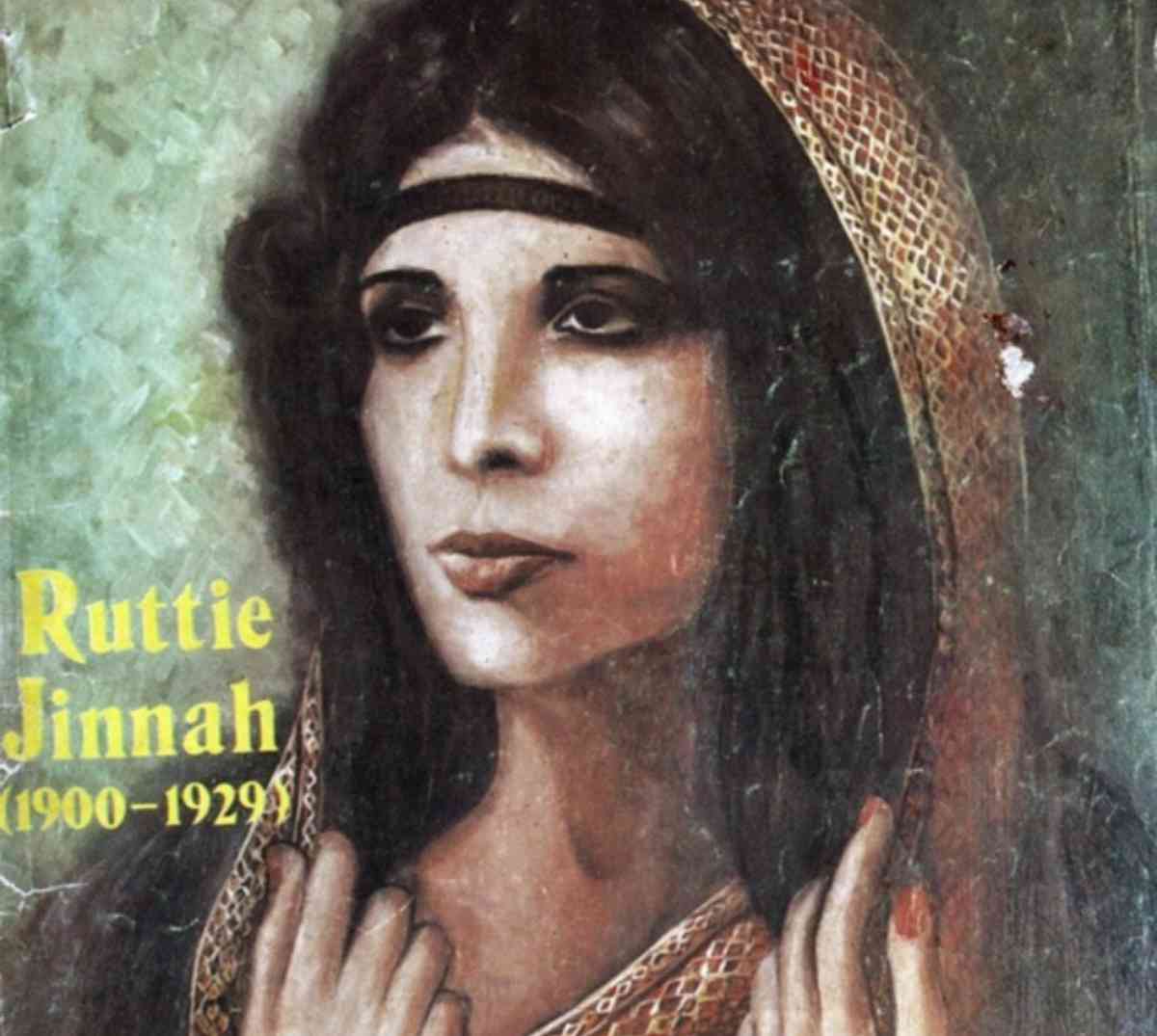
The Marriage that Shook the Country
On her eighteenth birthday, Ruttie stunned everyone by announcing that she would marry Muhammad Ali Jinnah.
A few weeks later, on April 19, 1918, she converted to Islam and became Ruttie Jinnah, in a marriage that would soon be described as “the marriage that shook India.”
Parsi publications mourned the day as “Black Friday,” and religious authorities declared Ruttie excommunicated. Overnight, the adored Parsi princess found herself isolated from the world she had known.
Yet Ruttie was no passive victim. Politically aware from a young age, she refused to be reduced to a decorative presence beside her husband.
She attended rallies, spoke passionately against British colonial rule, and shared the political stage with Jinnah rather than watching from the sidelines.
The Rose that Wilted
Their marriage, however, was not without strain.
Jinnah was deeply disciplined and purpose-driven; Ruttie was romantic, expressive, and yearned for emotional closeness.
After the birth of their only child, Dina, in 1919, the distance between them grew as Jinnah became increasingly consumed by politics. The “rose of Bombay” began to wilt due to a lack of attention.
In 1928, she travelled to Paris for medical treatment. On February 19th 1929, Ruttie passed away under circumstances still shrouded in ambiguity.
Jinnah was devastated with regret and grief. Eyewitnesses recalled him breaking down uncontrollably at her grave. He never remarried.
Final Letter
Ruttie’s final letter to Jinnah remains one of the most heartbreaking expressions of love ever written:
Dina Jinnah: Quaid-e-Azam’s Only Daughter, and What Happened To Her
Dina Jinnah was the only child of Muhammad Ali Jinnah. She was born in London on the night of August 14–15, 1919, while her parents were at a cinema.
Historians later noted the irony that she was born exactly twenty-eight years before the birth of Pakistan.
Her arrival softened Jinnah. At a time when he was under immense political pressure, Dina became his private refuge. He was a reserved man, but with his daughter, he allowed warmth, humour, and affection. That bond was tested early.
Dina lost her mother, Ruttie Jinnah, when she was just nine. After that, she was largely raised by her aunt, Fatima Jinnah.
Dina grew up independent and strong-willed, much like her parents. In 1938, at the age of nineteen, she chose to marry Neville Wadia, a Parsi businessman.
Jinnah strongly opposed the match. He believed she should marry a Muslim and feared she would face the same isolation her mother had endured.
Dina challenged him directly, reminding him that her own mother had been a Parsi. Jinnah’s response was firm: Ruttie had converted.
The marriage caused a rift. And yet Dina did not stop caring about her father or what he was building.
Letter to Her Father
In April 1947, months before Partition, she wrote to him with pride and tenderness, in a voice that feels both personal and historically haunting:
” My darling Papa,
First of all, I must congratulate you – we have got Pakistan, that is to say the principal has been accepted. I am so proud and happy for you – how hard you have worked for it…
I do hope you are keeping well – I get lots of news of you from the newspapers. The children are just recovering from whooping cough; it will take another month yet.
I am taking them to Juhu on Thursday for a month or so. Are you coming back here? If so, I hope you will drive out to Juhu and spend the day, if you like. Anyway, I have a phone, so I will ring you up and drive in to see you if you don’t feel like coming out.
Take care of yourself, Papa darling. Lots of love & kisses,
Dina “
(Letter to Jinnah, 28 April 1947)
After marriage, she stayed in India and did not move to Pakistan after the partition. She visited only twice, once for Jinnah’s funeral in 1948 and decades later in 2004.
Dina did not inherit her father’s property in Pakistan. Under Islamic law, her marriage to a non-Muslim disqualified her. She later challenged this in India, arguing that Jinnah followed Khoja customs governed by Hindu inheritance law.
The claim failed, and the house Jinnah built in Mumbai remained beyond her reach.
Her own marriage did not last too. After separating from Neville Wadia, Dina moved to New York, where she lived a largely private life. She raised two children, Nusli and Diana, and remained distant from politics, despite repeated invitations from Pakistan’s leaders.
Dina Jinnah died in New York in 2017 at the age of ninety-eight.
She was the daughter of a man who founded a nation, yet lived most of her life without a country that claimed her.
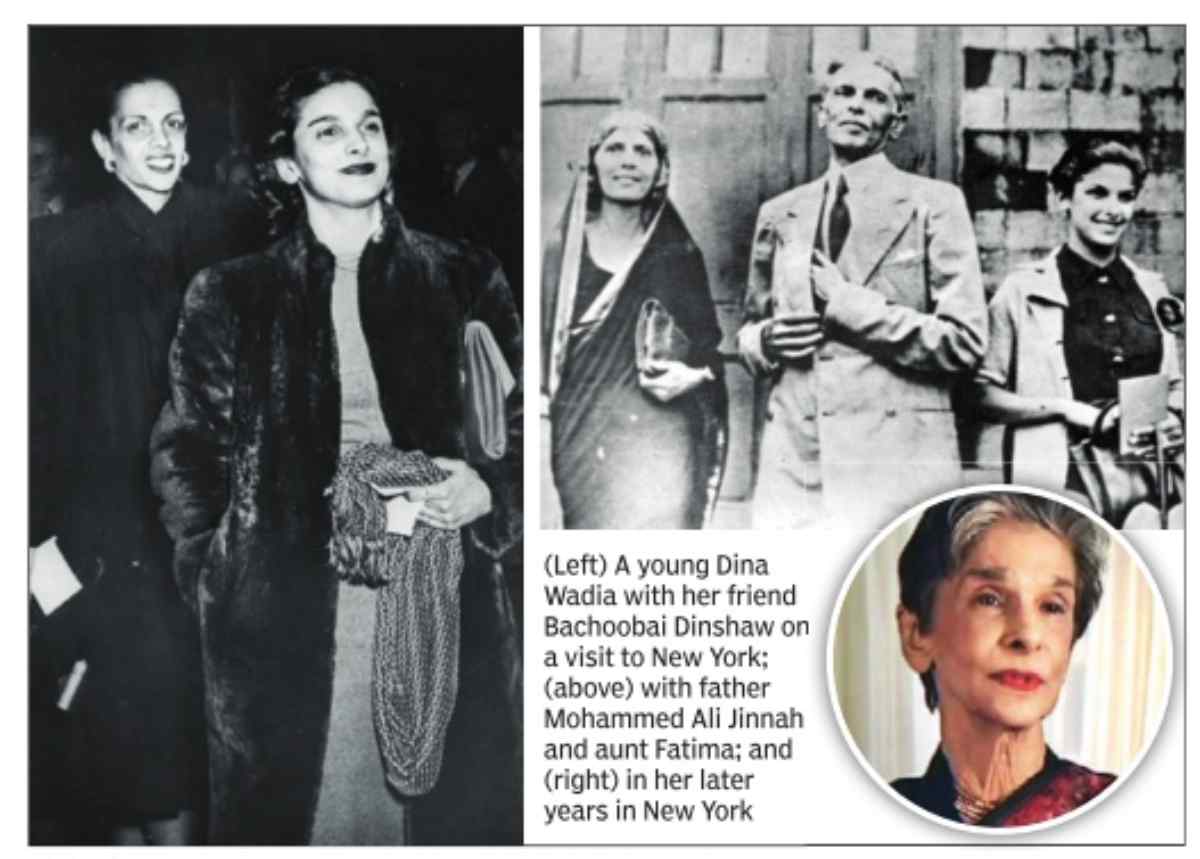
Jinnah’s Relationship With His Daughter
People have very different perceptions of the relationship between Muhammad Ali Jinnah and his daughter due to the marriage rift.
Jinnah’s relationship with Dina is often misrepresented as cold and permanently broken after her marriage. Researchers and historians have argued this is inaccurate, and Dina herself rejected the idea that her father disowned her completely.
Dina described Jinnah as reserved but affectionate in private. She recalled time with him in London, where he took her to theatres and circuses and shared an everyday family routine that the public never saw.
The main rupture came when Dina chose to marry Neville Wadia, a non-Muslim. Jinnah strongly disapproved, and they stopped speaking for a period.
However, the break was not permanent. Dina stated that when Jinnah was injured in an attempted knife attack in 1943, she called him and asked to see him. He agreed, and she went to him immediately.
In 1947, Jinnah phoned Dina to tell her Pakistan had been achieved. She congratulated him and later wrote to him with warmth and concern for his health.
Dina did not move to Pakistan. She first went there for his funeral in 1948, which she remembered as an immense public outpouring of grief.
Their relationship was strained by her marriage and his political position, but it did not end in total rejection.
Fatima Jinnah: Mother of The Nation Rigged During the 1965 Election
If one starts on the life of Fatima Jinnah, it is a separate topic on its own, of a woman of brilliance and resilience. But after Muhammad Ali Jinnah’s death, Fatima Jinnah was not provided with the due regard she deserved, given how much she had done for Pakistan.
When Fatima Jinnah stepped into the 1965 presidential race, she did not just challenge Ayub Khan; she challenged the idea that a controlled system could decide Pakistan’s future while the public watched from outside the gates.
First Presidential Elections
Pakistan’s first presidential election (2 January 1965) was not a direct vote. The president was chosen through an Electoral College of about 80,000 “Basic Democrats” under Ayub’s Basic Democracies framework. On paper, it looked like grassroots representation.
In practice, it narrowed power to a small pool that could be pressured, managed, and influenced far more easily than the entire population.
The opposition could not agree on a single leader, so they turned to the one figure who carried moral weight across the country: Jinnah’s sister, already known as Madar-e-Millat.
Crowds rallied for her in major cities, especially Karachi and Dhaka, exposing the breadth of her appeal beyond party lines.
But the contest was shaped to limit her. The campaign window was short, the election was indirect, and public-facing access was restricted through tightly controlled “projection meetings” aimed at the Electoral College rather than ordinary voters.
At the same time, she was hit with gendered attacks meant to cut her down to size. Ayub Khan mocked the idea of the “Mother of the Nation” stepping into politics, framing her dissent as a violation of how a “mother” should behave.
Ayub Khan ultimately won the Electoral College vote (about 62% to her 36%). The opposition rejected the outcome and alleged rigging and state interference.
The state tried to freeze her into a symbol, “sister” and “mother,” safe and silent. Her 1965 campaign broke that mould.
But we can’t help but question how tragic “the mother of the nation,” the sister of the very founder that we seemed to hold very dear, was treated.
How Fatima Jinnah’s Death Was Treated
Fatima Jinnah died on 9 July 1967 and was buried at Mazar-e-Quaid in Karachi. Her funeral drew massive crowds. Prayers were held at her residence and again at Polo Ground before the procession moved to the mausoleum.
The procession became disorderly near the mausoleum. Police used baton charges and tear gas, and reports noted injuries and at least one death during the clashes.
Afterwards, rumours spread that the public was kept from viewing her body closely and that there were marks of injury. In the early 1970s, a citizen petition seeking an inquiry was reported, but the controversy never received a clear, widely accepted public closure.
Muhammad Ali Jinnah’s Grandchildren: Where Are They Now
We know very little about our founder’s grandchildren, mainly because of how far from politics their life was.
His daughter Dina had two children with Neville Wadia: Nusli Wadia and Diana Wadia.
Nusli Wadia is one of India’s best-known industrialists and serves as the chairman of the Wadia Group, which includes companies such as Bombay Dyeing.
He has largely stayed away from public commentary on his grandfather’s political legacy, focusing instead on business and private life.
Diana Wadia chose a quieter path and remained largely out of the public eye. Through them, Jinnah’s lineage extends to the next generation: Ness Wadia and Jeh Wadia, both active in business and entrepreneurship.
Ness is involved in the Bombay Dyeing group and sports ventures, while Jeh founded low-cost airline GoAir.
Despite their prominence, the family has maintained distance from Pakistan’s political narrative.
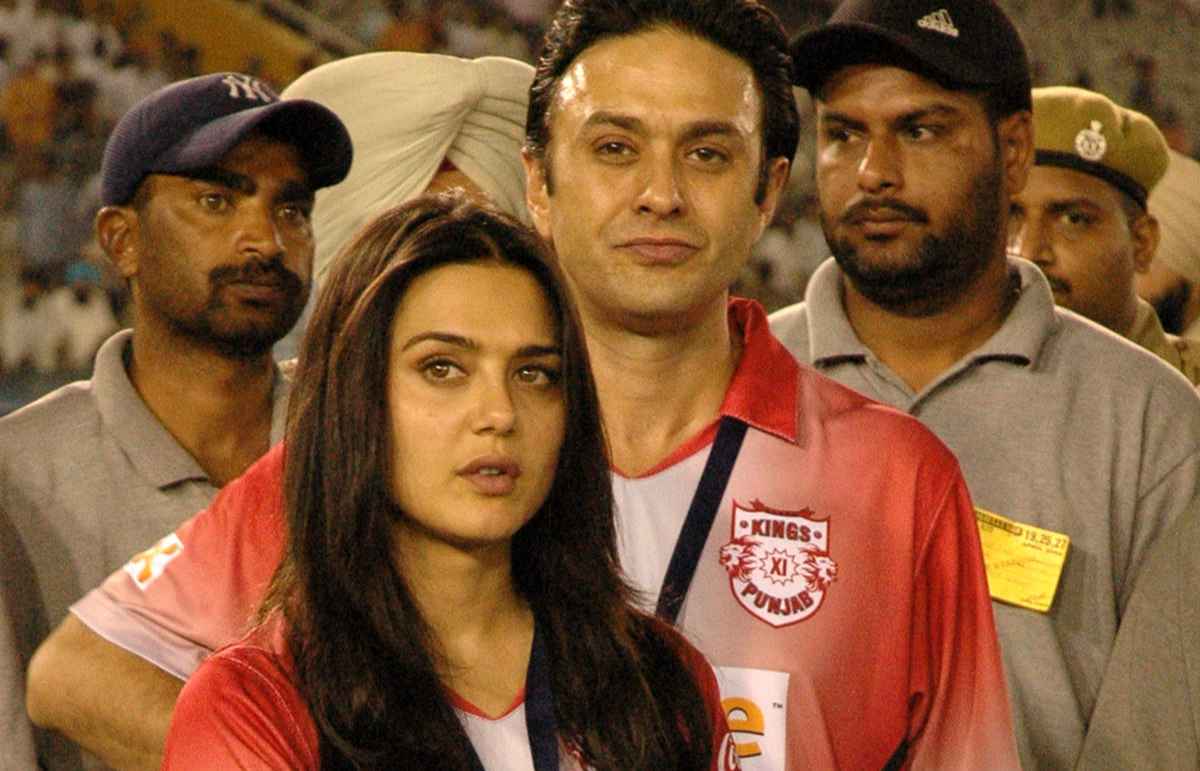
Ella Wadia’s Debut in Le Bal: Paris Debutante Ball
In 2023, Ella Wadia, Muhammad Ali Jinnah’s great-granddaughter, made her debut at Le Bal des Débutantes in Paris, one of the world’s most exclusive social events.
Held annually, Le Bal brings together young women from prominent families across the globe for a formal introduction to society.

Ella, the daughter of Ness Wadia, represented a rare moment where Jinnah’s lineage surfaced again, that too recently.
Ella’s debut highlighted how completely Jinnah’s family story had shifted. Her appearance at Le Bal quietly underscored the aftermath of Jinnah’s personal history.
The man who founded our country left behind a family that moved away from it, not in protest, but in silence. Disheartened by the lack of respect they always deserved.
Stay tuned to Brandsynario for latest news and updates