














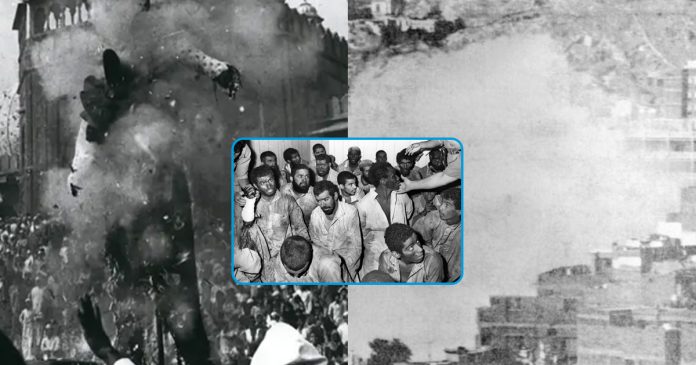

On November 20, 1979, the unthinkable happened in Islam’s holiest site. At the break of dawn in Mecca’s Grand Mosque, where tens of thousands of faithful had gathered for prayer, armed militants stormed the sanctuary.
For two weeks, the Kaaba itself was held hostage in what became known as the Siege of Mecca.
The Siege of Mecca
The late 1970s were a time of transformation in Saudi Arabia. Flushed with oil wealth, the kingdom was rapidly modernising. Consumer goods, cars, and television were becoming common, and in some regions, men and women began appearing together in public.
To religious hardliners, this was evidence of moral decay.
Among these was Juhayman al-Otaybi, a former soldier and radicalist who helped form al-Jamaa al-Salafiya al-Muhtasiba, a movement committed to rejecting modernisation in Saudi Arabia, which was specifically fueled after the revolution of Iran. Disillusioned with the royal family and the clerical establishment, Juhayman spread fiery sermons condemning secularism and Western ties.
Central to Juhayman’s message was the belief in the coming of Imam Mahdi, the Messiah, according to Islamic scriptures. He proclaimed that his brother-in-law, Muhammad ibn Abdullah al-Qahtani, fit the prophesied description: a man bearing the Prophet’s name, with distinct physical features, destined to restore justice.
By 1979, Juhayman and his followers were convinced Qahtani was the Mahdi. Rumours spread of visions and dreams confirming his divine role. With this conviction, they planned a dramatic strike: to seize the Grand Mosque on 1 Muharram 1400 AH, the symbolic dawn of a new Islamic century.

What Exactly Happened in The 1979 Siege of Mecca?
At dawn prayers, militants smuggled rifles and pistols into the mosque hidden in coffins. They quickly overpowered the guards, took control of the minarets, and sealed the gates. From the mosque’s loudspeakers, worshippers heard the chilling proclamation: “The Mahdi has arrived.”
Worshippers were terrified, some taken hostage, others scrambling to escape.
Saudi forces reacted immediately but suffered heavy losses. Snipers picked off soldiers, and the rebels fought from entrenched positions in corridors and underground catacombs. The stalemate dragged on, and only after religious scholars issued a fatwa permitting the use of force inside the holy mosque did the Saudis escalate.
Special units from the National Guard and the army, along with Pakistani troops, fought for days. Eventually, the Saudis secretly sought help from French GIGN commandos and the Pakistani army, who advised on using gas to flush rebels from the tunnels. After two harrowing weeks, the siege ended on December 4, 1979. Qahtani was killed in the fighting; Juhayman was captured alive.
This was the main point where the whole calling faltered and disappeared among the followers.
Internationally, the crisis sparked outrage. Iran’s Ayatollah Khomeini blamed the U.S. and Israel, inciting anti-American riots and embassy attacks across the Muslim world. Domestically, the Saudi monarchy tightened its alliance with conservative clerics. Modernisation slowed, female presenters disappeared from TV, and society entered a stricter era of religious conservatism that lasted nearly four decades.
On January 9, 1980, the 63 adult insurgents who had surrendered were publicly executed, beginning with Juhayman al-Otaybi. However, within the next few months, the government of Saudi Arabia noticeably ceased efforts toward Westernisation and instead embraced a more austere and conservative approach to Islam.
This conservatism reflected a deeper realisation within Saudi leadership that still has effects to this day. In this light, Juhayman’s ideological goals paradoxically found a form of realisation, albeit through the very government he sought to challenge.
Stay tuned to Brandsynario for latest news and updates



 Join a Channel
 Brandsynario
 Veryfilmi