















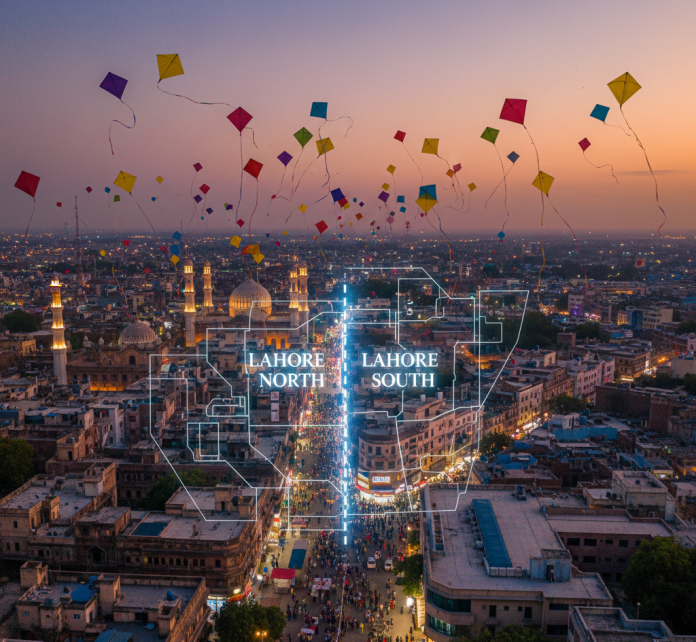

As Lahore gets ready to celebrate the return of the Basant festival this February, a major change is coming to the city. CM Maryam Nawaz has decided to split Lahore into two separate districts: Lahore North and Lahore South.
This plan will start right after the festival ends. The government believes Lahore’s 13 million people are too many for one administration to manage. By creating two districts, they hope to bring better management, more police, and faster services to every neighbourhood. Some call it a smart move, while others fear it will cause confusion and divide the city.
The Case for the Split: Driving Efficiency
The primary argument for the division is that Lahore has simply become too massive for a single administrative heart to pump life into every corner of the city.
1. Granular Infrastructure Management
Smaller districts allow for more focused urban planning. While South Lahore deals with rapid housing society sprawl and modern transit needs, North Lahore faces the challenges of heritage preservation and ageing sewage systems.
Two separate Deputy Commissioners can prioritise these vastly different local issues without one overshadowing the other.
2. Improved Law and Order Response
By splitting the police administration, the “span of control” for high-ranking officials is reduced. Instead of one DIG Operations overseeing the entire city, two dedicated command structures can focus on the specific crime patterns of their respective zones, such as street crime in congested northern hubs versus property disputes in the southern suburbs.
3. Faster Public Service Delivery
A smaller district means residents are physically and administratively closer to the decision-makers. Whether it is obtaining a building permit, resolving a property tax dispute, or managing localised waste collection, having a dedicated administration for your half of the city reduces the “red tape” and long queues at central offices.
4. Efficient Resource Allocation
Currently, the “favoured” areas of Lahore often receive the lion’s share of the budget. A formal split forces the government to allocate separate, dedicated budgets for North and South. This ensures that the older, more populated parts of the city (North) get their fair share of development funds instead of seeing them diverted to mega-projects in the newer areas.
The Case Against the Split: A Costly Distraction
Opponents argue that the city’s problems stem from poor management, not large boundaries, and that a split creates more problems than it solves.
1. Massive Administration Overhead
Creating a second district is not free. It requires new office buildings, new vehicles, and hundreds of new staff positions, from clerks to high-ranking officers.
Critics argue that these billions of rupees could be better spent on improving existing schools and hospitals rather than building a “parallel bureaucracy.”
2. Fragmentation of the City’s Identity
Lahore has always been defined by its unified cultural spirit. Dividing it into “North” and “South” could foster a social and economic divide, potentially branding the North as the “neglected old town” and the South as the “elite enclave.” This administrative border could eventually lead to a psychological rift among citizens.
3. Logistical Confusion for Citizens
Many of Lahore’s existing systems, like the Lahore Development Authority (LDA) or WASA, are currently unified. Splitting these into two could lead to a “jurisdictional nightmare” where citizens aren’t sure which office to visit.
If a road runs through both districts, or a sewage line crosses the boundary, the resulting “blame game” between the two administrations could lead to even more delays.
4. Risk of Development Inequality
Critics fear that splitting the city will lead to an “uneven Lahore,” where the two districts receive vastly different levels of attention based on their political or economic profiles.
If one district (likely the South) houses more influential businesses and elite residential schemes, it may naturally attract more private investment and government focus. This could leave the other district to struggle with the city’s “leftover” problems, such as industrial pollution and crumbling infrastructure, without the shared tax revenue of the wealthier half to balance the scales.
Ultimately, splitting Lahore into two districts is a bold attempt to fix the problems of a city that is growing too fast.
If it works, residents in both the North and South could see cleaner streets, safer neighbourhoods, and faster government help. However, success depends on more than just drawing a new line on a map; it requires real funding and clear rules so that one half of the city doesn’t get left behind.
As the kites of Basant come down and the new boundaries go up, only time will tell if this change will make Lahore more efficient or simply more complicated. For now, Lahoris must wait to see if “two Lahores” can truly serve the people better than one.
Stay tuned to Brandsynario for the latest news and updates

 Join a Channel
 Brandsynario
 Veryfilmi