

















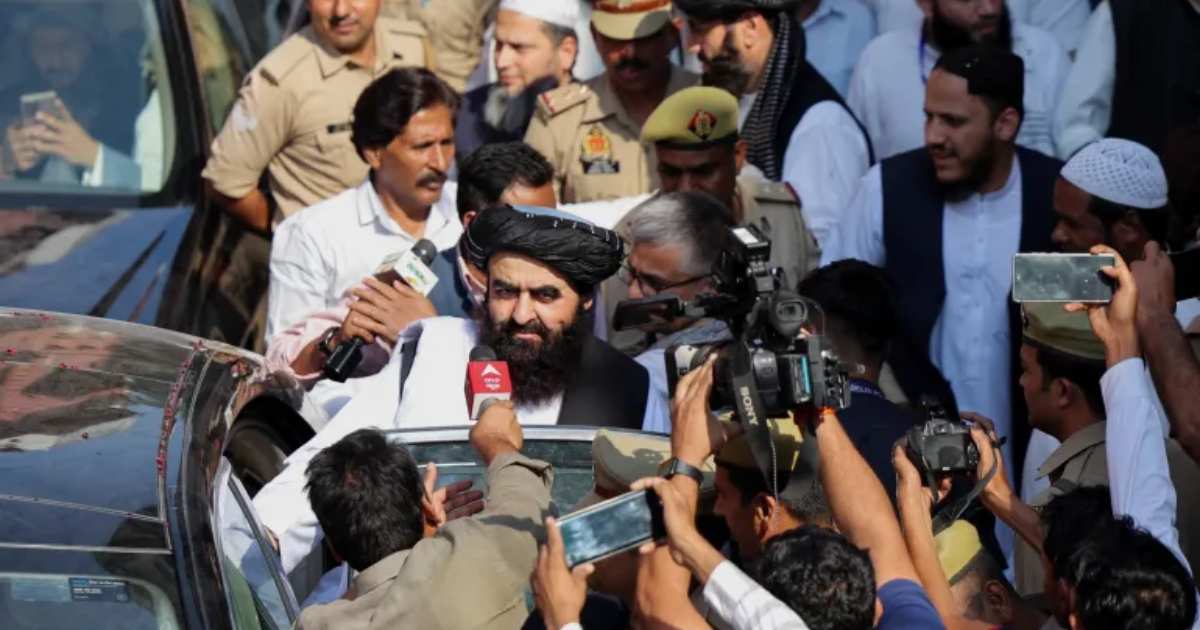
When Taliban Foreign Minister Amir Khan Muttaqi stepped onto Indian soil on his visit to India, the world couldn’t help but be amused at the irony.
For the first time since the Taliban seized Kabul in 2021, a senior Taliban leader was welcomed in New Delhi, enjoying a six-day tour that included a visit to the Taj Mahal and a meeting with India’s Foreign Minister S. Jaishankar.
This made many of us question: Are these the same “bad Taliban” that were flagged as terrorists by India but are now enjoying full freedom, in fact, more than other foreign guests? What kind of foreign policy is this?
Taliban Exposes India’s Foreign Policy Failure
The visit was made possible after the U.N. Security Council temporarily lifted a travel ban on Muttaqi. On the sidelines of the U.N. General Assembly, India seized the moment to announce it would upgrade its “technical mission” in Kabul into a full embassy, a move seen as a de facto recognition of the Taliban government.
Jaishankar described the decision as a step toward “regional stability and resilience,” signalling India’s intent to remain relevant.
The India visit followed Muttaqi’s Moscow stop, where he met Russian Foreign Minister Sergey Lavrov and joined a regional meeting that included representatives from China, India, and Pakistan.
Lavrov, in pointed remarks, warned against any renewed U.S. military presence, calling “extra-regional players” a source of instability.
With China and Russia establishing themselves as counterweights to U.S. influence, India finds itself in an uncomfortable middle ground. It is also eager to protect its regional interests but wary of appearing to endorse a regime notorious for repression.
India’s Calculus: Realpolitik Over Principle
After the 2021 collapse of the Ghani government, India lost billions in infrastructure investments and its foothold in Kabul. Pakistan quickly filled that void, while China deepened its own ties through investment and resource diplomacy.
Re-engaging with the Taliban, then, is less about ideological reversal and more about damage control and making their “enemy’s enemy their own enemy”.
Yet, critics argue that this pragmatic pivot comes at a steep reputational cost. For years, India positioned itself as a champion of democratic values and human rights. Now, it is cosying up to a government that bans girls from school, silences dissent, and persecutes minorities.
Since the Taliban’s takeover, Afghanistan has seen women erased from public life, minorities persecuted, and journalists silenced. The regime’s rigid interpretation of Islamic law has dismantled decades of social progress.
Religious minorities, especially Christians, Sikhs, Hindus, and Shia Hazaras, face existential threats. Converts from Islam risk death under Taliban law.
To call India’s engagement a “foreign policy failure” may be an overstatement, but it does expose the limits of New Delhi’s regional influence. After investing heavily in Afghanistan’s democratic transition, India is now negotiating from a position of necessity, not strength.
For the Taliban, the optics are clear: the world’s largest democracy is engaging on their terms.
Stay tuned to Brandsynario for latest news and updates

 Join a Channel
 Brandsynario
 Veryfilmi