














The article is written by Wajeeh ul Haque. He is an MBA student with more than six years of experience leading digital transformation in corporate organisations. He writes about how technology, skills and policy can turn Pakistan’s digital talent into a competitive export.
Somewhere in Abbottabad tonight, a young woman is cutting a video for a channel she has never watched, run by a man in Ohio she will never meet. She will be paid in dollars. She will not appear on screen or in the credits, and she will not show up in anything Pakistan publishes about its creator economy.
This ‘she’ is an invented example, but not an unlikely one. When IBA and the Indus Policy & Strategic Economic Collective convened “Screen to Scale” in September, the stated aim was to test whether the creator economy holds up in economic rather than cultural terms. Ask that question and the obvious place to look is the creators: the TikTok stars with millions of followers and the YouTubers whose brand deals make the news.
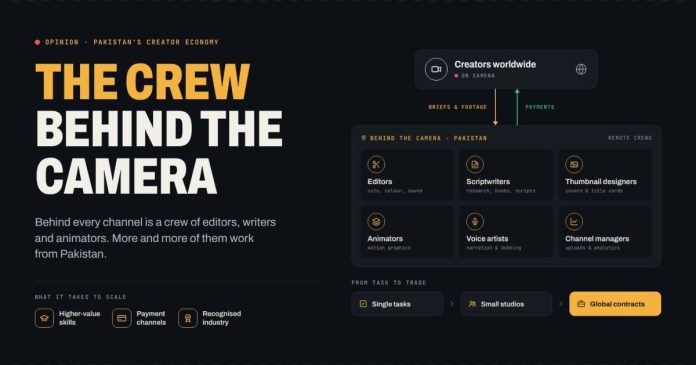
The less obvious place may matter more. Every serious creator depends on people who never appear on camera: editors, scriptwriters, thumbnail designers, animators, voice artists, channel managers. Pakistan cannot plan its way to a thousand global celebrities. It could, with some intent, become one of the places the world’s creators hire their crews from.
Goldman Sachs estimated the global creator economy at about $250 billion in 2023 and projected $480 billion by 2027, across roughly 50 million creators. Only around 4 per cent earn over $100,000 a year, but that top tier behaves like a collection of small media companies.
Writing in Dawn earlier this month, Nadeem Hussain described influencers turning into businesses with their own videographers, editors, researchers and sales teams. Syed Haris Ahmed made a similar point in The Express Tribune: each successful Pakistani channel functions as a small enterprise employing editors, scriptwriters, designers, animators and social media managers.
India gives a sense of scale. Oxford Economics estimated that YouTube’s creative ecosystem supported more than 960,000 full-time equivalent jobs in India in 2025, a figure that counts the wider web of work channels generate, not just the people in front of the lens.
Pakistan’s freelancers earned a record $1.76 billion in FY2025-26, according to State Bank data reported by ProPakistani. The more interesting figure sat beneath the headline: non-IT freelancers earned $592 million, up from $205 million, a jump of 188 per cent, while IT freelancing grew 49 per cent. The State Bank does not break the non-IT category down, but it is broadly where writing, design, marketing and other creative services fall.
A supply base is already forming. DigiSkills, the government’s online training programme, delivered 5.14 million training sessions between July 2025 and March 2026, in courses including content creation and graphic design. Thirty per cent of trainees were women.
The trouble is where most of this talent sits. A study published in August by the Mahbub ul Haq Research Centre at LUMS, covering more than 16,000 Pakistani freelancers on Upwork and Freelancer.com, found that software developers earned 46 per cent more than those in Design and Creative, and game designers about 67 per cent more. The Express Tribune’s editorial board has warned that artificial intelligence may increasingly automate routine digital services, and much creative freelancing is exactly that kind of task work: a thumbnail here, a short clip there, paid by the piece.
The Philippines shows another path. Its IT and business process management sector passed $40 billion in revenue in 2025, according to the industry body IBPAP, and Western creators routinely hire Filipino editors and channel managers through agencies built for the purpose. Part of the Filipino edge is packaging: firms that sell a reliable service rather than individuals selling hours.
The LUMS study also upset a familiar assumption, that digital work belongs to the big cities. Holding skills, platform and gender constant, freelancers in Abbottabad earned roughly nine times as much as those in Karachi, and those in Attock about seven times. Of the 68 cities with at least 20 freelancers in the sample, 27 out-earned Karachi.
For women, the case is strong but more complicated. Female labour force participation was 24.4 per cent in 2024-25, according to the Labour Force Survey, and remote production work fits around the mobility limits and family expectations that keep many women out of offices. Yet women were only 15 per cent of the LUMS sample, clustered in crowded, lower-paid fields such as writing and design, and earned about 20 per cent less than men after controls.
From where these freelancers sit, motivation is not the missing piece. What they lack is a route from task to trade: training in higher-value skills such as motion graphics, animation, scripting for foreign audiences and dubbing, plus portfolios and mentors. They also lack an easy way to get paid. Tufail Ahmad Khan of the Global Freelancers Union told Arab News that without PayPal or a major international payment system, “their income is being eaten up simply due to the lack of proper channels.”
Back in 2021, Umair Kazi argued in Aurora that digital literacy was not enough and that young Pakistanis needed “creative literacy”: video editing, audio, animation and an understanding of copyright. Five years on, that reads like a curriculum Pakistan never got round to writing.
As Ahmed notes, digital services rely on people and connectivity rather than imported inputs, so they keep earning through currency shocks, and they let skilled young people earn global incomes without emigrating. With unemployment among 15-to 24-year-olds at 12.6 per cent, work that can be done from a bedroom in Jhelum is not a small thing.
The risks are real. Production work depends on platforms Pakistan does not control, and AI editing tools are making the low end of the market fragile. Policy can shift quickly too: the Finance Act 2026 has already pulled creators out of the concessionary tax regime for IT exporters, and it is not yet clear how service providers working for foreign creators will be treated.
Pakistan’s creator economy has a second, largely invisible export layer, and it is growing faster than anyone gives it credit for. Treating it as an industry would mean, first, naming it: the State Bank and the Pakistan Software Export Board could recognise creative production services as a distinct category, so their growth is measured and their tax treatment settled.
It would mean moving training up the value chain, with DigiSkills and universities offering advanced tracks in animation, localisation and storytelling, aimed deliberately at women and smaller cities. It would mean helping freelancers form small studios that bid for whole contracts rather than single tasks. And none of it works without payment channels that stop eating into the income.
The obvious gap for further research is basic: nobody knows how many Pakistanis already work behind the camera for foreign creators, or what they earn. Pakistan may never produce the world’s biggest YouTuber. It could produce the people that YouTubers cannot work without.
The views expressed in the publication are not necessarily those held by Brandsynario or any associate companies and/or persons.
Stay tuned to Brandsynario for the latest news and updates.

 Join a Channel
 Brandsynario
 Veryfilmi