













To observe a nation’s history through its major political milestones is to see only half the picture. The other half lives in everyday material culture the objects, slang, music, and social rituals that quietly define how a society eats, celebrates, and expresses itself.
For 73 years, Coca-Cola has occupied a peculiar and fascinating place in Pakistan’s anthropological landscape. It arrived as a novelty, but over seven decades, something unexpected happened: Pakistani culture consumed the brand right back. Rather than remaining an alien global symbol, the brand was localized, repurposed, and woven directly into the country’s vernacular, pop music, high fashion, and everyday rituals of hospitality.
To trace the journey of a global brand such as Coca-Cola in Pakistan is to study how a global artifact becomes a mirror for a thriving nation’s evolving identity. The brand has been operating in Pakistan since 1953, and today its seven production units spread across the country employ more than 2,100 Pakistanis directly and contribute to the economic prosperity of thousands across its value chain.
When the iconic glass bottle first appeared in urban centers like Lahore and Karachi in the early 1950s, it entered a society where hospitality was, and remains, a foundational social currency. In traditional South Asian etiquette, offering a guest plain water is insufficient; honor demands offering something cold, sweet, and ceremonial. Coca-Cola filled that space for millions of households.
The glass bottle fit seamlessly into this cultural imperative. It carried a tactile ritual: the popping of the crown cap, the dark effervescence, and the condensation on thick glass in the oppressive summer heat. It was quickly absorbed into the domestic sphere, sitting alongside traditional pulaos and karahis at family gatherings and becoming a staple of urban street-corner dhabas.
Archival photographs from this era do not merely show a beverage; they document the early spaces of Pakistani urbanization. The bottle became an anchor for the baithak—the traditional informal gatherings where intellectuals, workers, and students met to debate politics and culture over a round of cold drinks.
The true mark of a brand’s anthropological integration is when it enters a society’s folk register and pop language. By the mid-20th century, the brand was no longer just something drunk from a bottle; it had become a metaphor in Pakistani pop culture.
As Pakistani society navigated the 1960s, visual art and fashion began incorporating the brand’s iconography into regional aesthetics. In the realm of street art, truck artists, the famous custodians of Pakistan’s visual folk culture, began painting the distinctive red-and-white script alongside Urdu poetry, floral motifs, and portraits of legendary singers on the sides of massive Bedford trucks navigating the newly built highways. By the 1970s, this visual synthesis reached high fashion. Pakistani designers coined and popularized the “Coca-Cola cut”—a specific hourglass silhouette for the kurti and shalwar kameez that mimicked the famous contour of the vintage glass bottle. What started as an industrial package design had transformed into a staple term within Lahore and Karachi’s high fashion ateliers and local tailoring shops alike, proving that the brand’s visual identity had been thoroughly translated into local sartorial design.
But nothing illustrates this better than the legendary 1984 Lollywood track sang by the legendry Noor Jehan for the film Chan Te Soorma, “Zalima Coca-Cola Pila De” (O cruel one, buy me a Coca-Cola!).
In the anthropological context of Pakistani cinema, the phrase was revolutionary. It used the brand as a playful, romantic plea; a modern object of desire embedded within classic Punjabi folk phrasing. The song became a permanent fixture of national folklore, sung at weddings, street parades, and radio broadcasts for decades. It signaled that the country had taken a global brand and converted it into local street slang and artistic expression.
If film and fashion localized the brand’s image, music internalized its soul. In 2008, the launch of Coke Studio marked one of the most significant cultural experiments in modern South Asian history.
At a time when Pakistan was navigating a complex political landscape and identity search, the platform offered a radical sonic space. It brought together ancient Sufi qawwals, regional folk singers, classical instrumentalists, and young hip-hop and rock musicians under one roof.
Interestingly, Coke Studio was not perceived by the public as an advertising campaign; it was received as a cultural rejuvenation project. It revived dying regional languages – Siraiki, Balochi, Pashto, Sindhi, and Punjabi – and broadcast them to millions of young Pakistanis and a global diaspora. It shifted the brand’s role from a passive observer of Pakistani culture to an active curator of its modern heritage.
Today, Coke Studio stands as Pakistan’s number one cultural export, streamed in over 184 countries and generating more than 6.2 billion views globally. It plays a critical role in reinforcing Pakistan’s global image while contributing to the growth of the country’s cultural and creative economy.
Looking back over 73 years, the story of Coca-Cola in Pakistan has many lessons for global brands that struggle to build strong and honest local connect with consumers. It always pays better dividends to be less about corporate distribution and more about cultural osmosis.
A nation does not adopt a global brand into its folk songs, sartorial cuts, street art, and musical identity unless it sees something of its own reflection in it. The glass bottle on a roadside dhaba table, the playful refrain of a 1960s film song, and the fusion of Sufi poetry on a global stage are all chapters in a single story of shared cultural history.
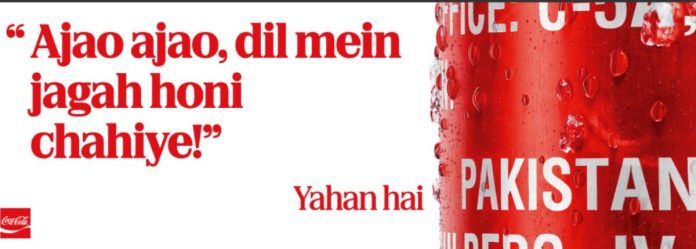
This decades-long journey provides the deep context for the campaign thought, “Yahan Hai Pakistan”, with which Coca-Cola Pakistan is marking the 79th Independence Day of the country. When we search for Pakistan’s identity, we must find it in these layered, hybrid cultural moments where global influences and local traditions melt together. Coca-Cola’s Yahan Hai Pakistan campaign is not inventing a connection; it is merely pointing to 73 years of lived history and reminding us that the spirit of the nation has always lived right here in the songs we sing, the rituals we share, and the everyday warmth that continues to bring Pakistanis together.
Stay tuned to Brandsynario for Latest News and updates

 Join a Channel
 Brandsynario
 Veryfilmi