













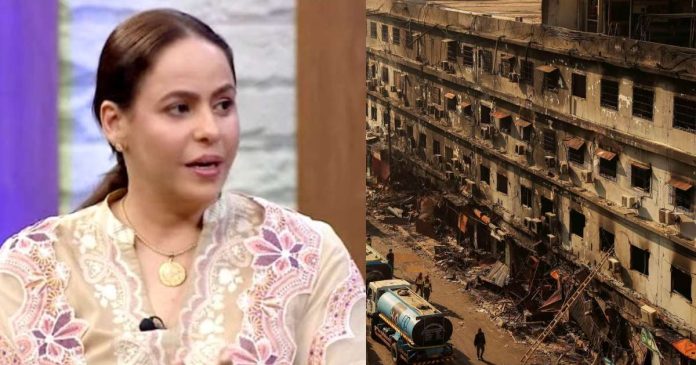

The tragic Gul Plaza fire in Karachi has once again forced Pakistan to confront an uncomfortable and deeply disturbing reality. As flames consumed the building, approximately 30 lives were lost, while more than 60 people remain missing, their fates buried under rubble, negligence, and silence. Yet, as rescue operations struggled and families waited in agony, a parallel Pakistan unfolded online—one filled with luxury, celebrations, and breathtaking indifference. It was this contrast that pushed Zainab Qayyum to speak out, and when she did, her words struck a nerve across the nation.
The actress did not cloak her emotions in diplomacy. Instead, she laid bare what many Pakistanis feel but hesitate to articulate. Through her Instagram story, Zainab Qayyum described witnessing “two Pakistans” on her social media feed. On one side stood the elite—the untouched, the protected—celebrating a lavish wedding, discussing designer outfits, Botox, and glamour. On the other side burned the working class, trapped in a collapsing economy, suffocating under debris, and dying without hope for justice or accountability. Her words were raw, unapologetic, and painfully accurate.
View this post on Instagram
This was not merely commentary on a tragic incident. Rather, it was an indictment of a system that has normalized inequality to the point where suffering no longer disrupts celebration. Consequently, Zainab Qayyum’s statement resonated far beyond the entertainment industry. It became a mirror reflecting a society fractured by wealth, power, and a rapidly eroding moral conscience.
Two Pakistans on One Screen: Elite Privilege Versus Working-Class Survival
The Gul Plaza fire did not just expose structural failures; it exposed emotional and ethical ones. While grieving families searched for answers, Pakistani social media presented a jarring split-screen reality. Wedding festivities hosted by a government official dominated timelines, complete with glittering décor, celebrity guests, and designer fashion. At the same time, images of smoke, firefighters, and desperate relatives pleading for information struggled to receive equal attention. This contrast was not accidental—it was systemic.
Zainab Qayyum’s observation captured this imbalance with chilling clarity. She highlighted how the elite remain “unharmed” and “untouchable,” insulated from consequences that routinely devastate the working class. The victims of Gul Plaza were not faceless statistics; they were laborers, office workers, and breadwinners whose lives ended due to preventable failures. Yet, their deaths barely interrupted the rhythm of privilege enjoyed by those at the top.
Moreover, public reaction online underscored how deeply this divide has embedded itself into collective consciousness. Social media users echoed Zainab’s sentiments with heartbreaking honesty. Many admitted they had witnessed this disparity since childhood, but acknowledged that it has intensified alarmingly. One user described it as “Karachi versus the whole of Pakistan,” a statement that encapsulates the city’s long-standing neglect. Another comment pointed out how the rich continue to grow richer through public taxes, while common people literally burn. These reactions were not driven by envy; they were fueled by exhaustion and grief.
The widening class divide has also eroded empathy. Several users lamented the absence of moral conscience, noting how luxury and survival now coexist without discomfort. Between designer weddings and disaster sites lies the real Pakistan—a nation where privilege shields some from tragedy while others pay with their lives. This is not coincidence; it is the result of years of unchecked inequality and selective accountability.
Why Zainab Qayyum’s Words Matter in a Culture of Silence
In a society where celebrities are often expected to remain neutral, Zainab Qayyum’s stance carried significant weight. She did not attempt to soften her message or balance it with performative sympathy. Instead, she confronted the cruel class divide head-on, refusing to normalise the disparity between elite excess and working-class suffering. Her words mattered because they disrupted complacency at a moment when silence would have been easier.
Public figures possess visibility, and with visibility comes influence. Zainab used hers not to amplify glamour but to highlight injustice. By doing so, she challenged the unspoken rule that tragedy should not interfere with celebration. Her statement reframed the conversation from isolated disaster to systemic failure. It questioned why accountability remains elusive when working-class lives are lost, yet power structures remain untouched.
Furthermore, her comments sparked a broader dialogue about responsibility. The Gul Plaza fire was not an unavoidable accident; it was the outcome of negligence, poor enforcement, and indifference toward safety regulations. When such incidents repeatedly claim lives, grief alone becomes insufficient. As Zainab’s words implied, empathy without action is hollow. Condolences without consequences serve only to protect those already shielded by privilege.
The public response demonstrated that many Pakistanis are no longer willing to accept this imbalance quietly. Agreement poured in not because her words were shocking, but because they articulated a shared reality. People recognized themselves in her frustration. They recognized their city, their struggles, and their anger in her description of two Pakistans existing side by side, yet worlds apart.
Ultimately, the Gul Plaza tragedy and Zainab Qayyum’s reaction to it reveal a nation at a crossroads. One path continues toward normalised inequality, where luxury drowns out loss. The other demands accountability, empathy, and structural change. Her statement did not offer solutions, nor did it pretend to. Instead, it forced a reckoning—a reminder that between celebration and catastrophe lies a moral choice.
Pakistan cannot afford to keep looking away. As long as class divides dictate whose lives matter and whose deaths fade quietly, tragedies like Gul Plaza will continue to repeat themselves. Zainab Qayyum’s words linger because they ask a question that refuses to disappear: How long will survival remain a privilege rather than a right?
Stay tuned to Brandsynario for the latest news and updates

 Join a Channel
 Brandsynario
 Veryfilmi