














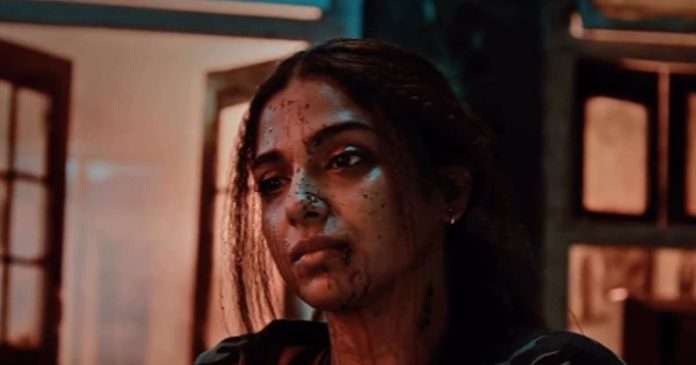

The internet does not pause when something extraordinary happens on screen. It reacts, it searches, and it obsesses. That is exactly what is unfolding after Sonya Hussyn shared a six-minute, single-take scene from Daadal, a film that quietly existed until it suddenly did not. In a matter of hours, searches for “Daadal movie”, “Sonya Hussyn Daadal scene”, and “Abu Aleeha Lyari film” began climbing, fueled by curiosity, emotion, and the raw power of a performance that refuses to be ignored.
There is something unsettling yet magnetic about a scene that leaves its actor crying long after the camera stops rolling. Sonya Hussyn’s confession that she could not control her tears once the take ended has only intensified the intrigue. This was not scripted drama spilling over for publicity. This was emotional residue, the kind that lingers because the character’s pain becomes inseparable from the performer’s own heartbeat. Viewers sensed that truth immediately, and that truth is what is now pushing Daadal into conversations it was never loudly marketed for, yet deeply deserves.
Before the spotlight of Bollywood ever wandered into Lyari, Abu Aleeha had already dared to tell its story with Daadal, a film named after Rehman Dakait’s father. That detail alone adds a layer of historical weight and cultural gravity that makes the project impossible to dismiss as just another crime drama. It is rooted, it is intimate, and it is painfully aware of the lives it portrays. When Sonya Hussyn steps into that world in one uninterrupted take, the result feels less like acting and more like witnessing something you were never meant to see.
Sonya Hussyn’s One-Take Breakdown That Refuses to Let Viewers Look Away
A six-minute single-take scene is not designed for comfort. There are no cuts to hide behind, no edits to soften a moment that hits too close to home. Sonya Hussyn carries the entire emotional architecture of the scene on her shoulders, and she does so with a control that feels almost dangerous. Her breathing, her pauses, and her silences speak louder than dialogue ever could. This is the kind of performance that does not beg for applause but demands respect.
Watche here:
View this post on Instagram
What makes this scene unforgettable is not just its length or its technical difficulty. It is the emotional precision with which Sonya Hussyn navigates despair, fear, and restrained rage. She does not escalate unnecessarily. She lets the moment breathe, allowing the audience to feel trapped inside the scene with her. That claustrophobic intensity is why viewers find themselves rewatching the clip, searching for Daadal, and trying to understand how something so heavy slipped under the radar for so long.
Sonya Hussyn’s revelation that she kept crying after the shot ended has added fuel to an already roaring fire. In an industry where emotional scenes are often rehearsed to perfection and quickly shaken off, her reaction exposes the cost of authenticity. The pain did not dissolve with a director’s call of cut. It stayed. That honesty resonates deeply in an era where audiences crave real emotion over polished spectacle.
Her praise for Abu Aleeha’s sensitivity and control is not casual admiration. It is acknowledgment of a director who understands that heavy scenes require restraint, not exploitation. Abu Aleeha does not force the emotion; he frames it, respects it, and lets it unfold naturally. That balance is rare, especially when dealing with narratives connected to real people, real neighborhoods, and real histories. It is evident that this scene was not designed to shock but to scar quietly, leaving a mark that viewers carry with them.
The absence of background noise, dramatic music cues, or visual distractions allows Sonya Hussyn’s performance to dominate the frame completely. Every second counts. Every expression matters. This is why audiences are not merely impressed; they are shaken. The scene does not entertain in the conventional sense. It confronts. It challenges. And in doing so, it elevates Daadal from a film title to a cultural talking point.
Why Daadal Is Being Rediscovered as Lyari’s Most Fearless Storytelling Moment
Daadal is not suddenly relevant because of a viral clip. It was always relevant. It is being rediscovered because audiences are finally paying attention. Long before Lyari became a cinematic backdrop for mainstream Indian films, Abu Aleeha had already ventured into its layered reality. Naming the film after Rehman Dakait’s father was not a sensational choice. It was a statement, one that positioned the film within a lineage of stories often misunderstood or oversimplified.
This is where Daadal separates itself from surface-level portrayals of crime and conflict. It does not romanticize violence, nor does it sanitize it. The film understands Lyari as a living, breathing entity shaped by loss, loyalty, and survival. Sonya Hussyn’s scene acts as an emotional gateway into that world, making viewers realize that this story carries more weight than headlines ever could.
The renewed interest in Daadal also highlights a larger shift in audience behavior. Viewers are no longer satisfied with formulaic storytelling. They seek narratives that challenge them emotionally and ethically. Sonya Hussyn’s performance serves as proof that Pakistani cinema is capable of delivering moments that rival global standards of realism and intensity. This is not comparison for validation. It is recognition earned through craft.
Abu Aleeha’s direction deserves particular attention because of how deliberately he handles emotional extremes. There is no excess, no indulgence. The camera becomes an observer rather than a manipulator. That approach allows actors like Sonya Hussyn to explore emotional depths without feeling exploited by the frame. It is a collaboration rooted in trust, and that trust is visible on screen.
The reason people are searching for Daadal now is simple. They have tasted something raw, and they want the full experience. A single scene has opened the door to a film that challenges perceptions, confronts uncomfortable truths, and refuses to dilute its message for mass appeal. In a digital landscape crowded with fleeting trends, this kind of sustained curiosity is rare and telling.
As conversations around the film grow, Daadal is being repositioned not as a forgotten project but as a bold cinematic statement that arrived ahead of its time. Sonya Hussyn’s scene has become its emotional ambassador, drawing attention to a story that was always waiting for the right moment to be heard. That moment is now.
The resurgence also speaks volumes about the power of performance-driven storytelling. No marketing gimmick could have engineered this response. It was one actor, one director, one uninterrupted take, and an audience ready to feel something real. This is why Daadal is no longer just a film title. It is a search term, a conversation starter, and a reminder of what cinema can achieve when it dares to be honest.
Stay tuned to Brandsynario for the latest news and updates

 Join a Channel
 Brandsynario
 Veryfilmi