














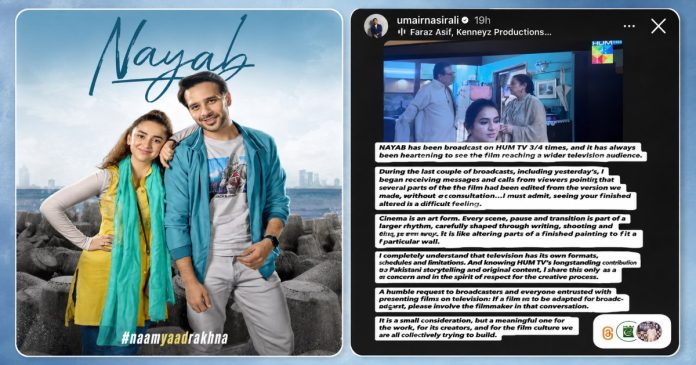

Filmmaker Umair Nasir Ali has demanded greater creative respect after his award-winning film Nayab aired on HUM TV, with several scenes cut without consulting the filmmaking team. The experience, he said, “left me with a difficult feeling,” particularly since one of the film’s key emotional moments was not included in the televised version.
The issue has sparked a wider conversation about filmmakers’ creative control, television edits, and how completed films are treated when they move from cinemas to television.
Key Takeaways
- Nayab director Umair Nasir Ali criticised the removal of scenes from the film’s television broadcast.
- The film aired on HUM TV with several scenes missing.
- Ali said the filmmaking team was not consulted before the edits were made.
- A key emotional scene between Yumna Zaidi’s Nayab and her brother Akka, played by M Fawad Khan, was removed.
- The director acknowledged that television has different limitations but urged broadcasters to involve filmmakers before making significant changes.
- Ali compared altering a finished film to changing a completed painting to fit a particular wall.
Nayab Scenes Cut During HUM TV Broadcast
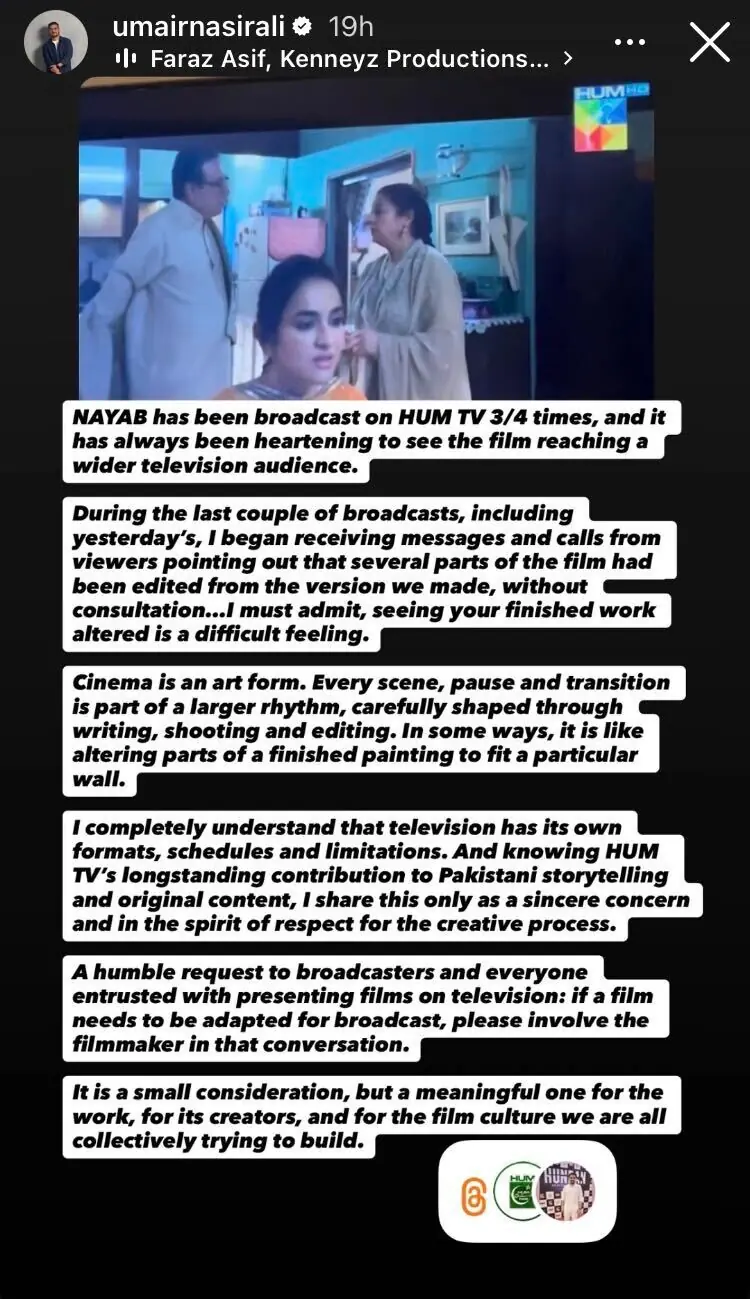
On Sunday, Umair Nasir Ali stated that Nayab would be aired on HUM TV, which included cuts from the original version. Later, the director went on Instagram Stories to speak about the situation, stating he was disappointed that the end product was changed without a discussion first.
For Ali, the issue extended beyond the deletion of individual scenes. He considered the film a finished work of art deserving consideration before broadcasters reshaped it for television.
“I think, as filmmakers in general, we are making choices about scenes and pacing and emotional progression,” said the director. Thus, cutting a particular scene can affect more than a film’s length; it can also change the way in which audiences understand characters and their relationships.
A Key Emotional Scene Was Removed
Ali revealed that an important emotional moment between Nayab, played by Yumna Zaidi, and her brother Akka, played by M Fawad Khan, was not included in the broadcast on HUM TV, specifically referring to the televised version.
The scene held significant meaning within the emotional architecture of the film, and its elimination represented a major decision by the director.
When a filmmaker constructs a story from relationships and character development, individual scenes can inform what later moments rely on. Therefore, such a scene may have to be cut to preserve the emotional impact of the story for viewers of the television version who have not seen the original movie.
Umair Nasir Ali Calls Cinema an Art Form
“A finished film is like a finished painting,” said Ali. “Cinema is an art form.”
His analogy was this: to change a finished film for the sake of television, and without the consent of the film’s creator, is like changing a finished painting simply because it doesn’t fit a particular wall.
The director did not dismiss the need for TV adaptations entirely. Instead, he acknowledged that broadcasting has its limits and sometimes needs editing.
He was worried about the process of edits, not the fact that they existed.
Director Wants Filmmakers Included in Editing Decisions
Ali’s main request was simple: broadcasters should talk to filmmakers about major edits.
This involvement can be beneficial for directors in helping broadcasters understand which scenes are of vital narrative or emotional value. It can also help both sides discover practical solutions without sacrificing the story needlessly.
The director’s comments, therefore, highlight an important question about the transition of Pakistani films from cinema to television.
A film could have undergone a long creative process before it reaches cinemas. Broadcasters will alter that work later, and filmmakers naturally want their artistic decisions to be respected.
Why Television Versions May Differ From Films
Television can be a different medium from the cinema and has different needs. In preparing a film for television, broadcasters may need to take into account the runtime, programming schedules, broadcast standards and content restrictions.
Ali’s statement recognised these realities.
But the Nayab director said such requirements should not be a barrier to broadcasters talking to the original creative team. A collaborative approach could help preserve key story elements while meeting the demands of television.
Yumna Zaidi’s Nayab at the Centre of the Discussion
The story revolves around the journey of the characters and their relationships. Nayab stars Yumna Zaidi in the lead role.
An important emotional element of the film is the relationship between Nayab and her brother Akka. So, the excision of a key scene between the siblings has revealed the effect of editorial choices on a character-driven story.
The missing scene could also influence viewers’ understanding of the characters, especially for those watching Nayab on television for the first time without being aware that additional material exists in the original version.
A Bigger Debate About Creative Ownership
This controversy over Nayab opens a bigger conversation around creative ownership in Pakistan’s showbiz.
When a filmmaker finishes a project, choices about cinematography, editing, dialogue, performances and narrative structure all come together to produce the finished product. Any major change has the potential to impact that original vision.
Ali’s comments do not just challenge a single television broadcast. They ignite a wider discussion on how to improve communication between filmmakers and broadcasters when theatrical films move to the small screen.
FAQs
Who directed Nayab?
Nayab was directed by Umair Nasir Ali.
Why were scenes cut from Nayab?
The specific reasons for the individual cuts were not detailed in the provided statement. Ali acknowledged that television has limitations but objected to the changes being made without consulting the filmmaking team.
Which scene was removed from the televised version of Nayab?
According to Ali, a key emotional scene between Nayab, played by Yumna Zaidi, and her brother Akka, played by M Fawad Khan, was removed.
What did Umair Nasir Ali say about the cuts?
Ali said altering a finished film without involving its creators created a difficult feeling for him. He urged broadcasters to include filmmakers in discussions about significant edits.
Did Ali oppose all television edits?
No. He acknowledged that television has limitations and that some edits may be necessary. His concern focused on the lack of consultation with the filmmaking team.
Who stars in Nayab?
Yumna Zaidi plays the lead character Nayab, while M Fawad Khan plays her brother Akka.
Stay tuned to Brandsynario for latest Entertainment news and updates.

 Join a Channel
 Brandsynario
 Veryfilmi