















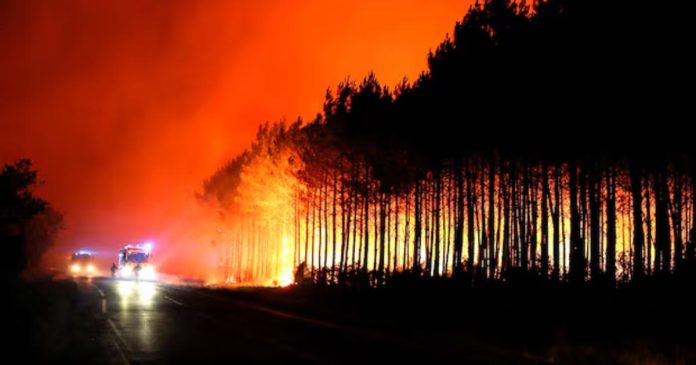

More than 250,000 people have now been evacuated across France and Spain as some of Europe’s most destructive wildfires in recent years continue to spread. Entire towns, holiday resorts and suburbs have been cleared, while authorities warn that several fires remain out of control.
France has appealed for international assistance, Spain has declared a national emergency, and both governments have mobilized military resources as firefighters battle relentless heat, strong winds and severe drought.
Key Takeaways
- More than 250,000 people have been evacuated across France and Spain as wildfires continue to spread.
- France has evacuated nearly 200,000 people in the Gironde and Landes regions, including suburbs near Bordeaux.
- Spain has declared a national emergency, with around 70,000 evacuations reported as fires rage near Madrid.
- Multiple fires west of Madrid have merged into a massive blaze that officials say is beyond firefighters’ capacity to contain.
- France has requested international assistance through the European Union while both countries have deployed military resources.
- Scientists say prolonged heatwaves and drought linked to climate change are creating ideal conditions for larger and more destructive wildfires.
France Battles Historic Wild Fires Near Bordeaux
The wildfire crisis in southwestern France continues to worsen, with authorities ordering fresh evacuations around Bordeaux after flames advanced toward populated areas.
Nearly 200,000 residents and holidaymakers have now been forced to leave the Gironde and Landes regions. The latest evacuation orders affected several suburbs near Bordeaux, including Le Haillan, Eysines and Mérignac, after officials warned the fires showed no signs of slowing.
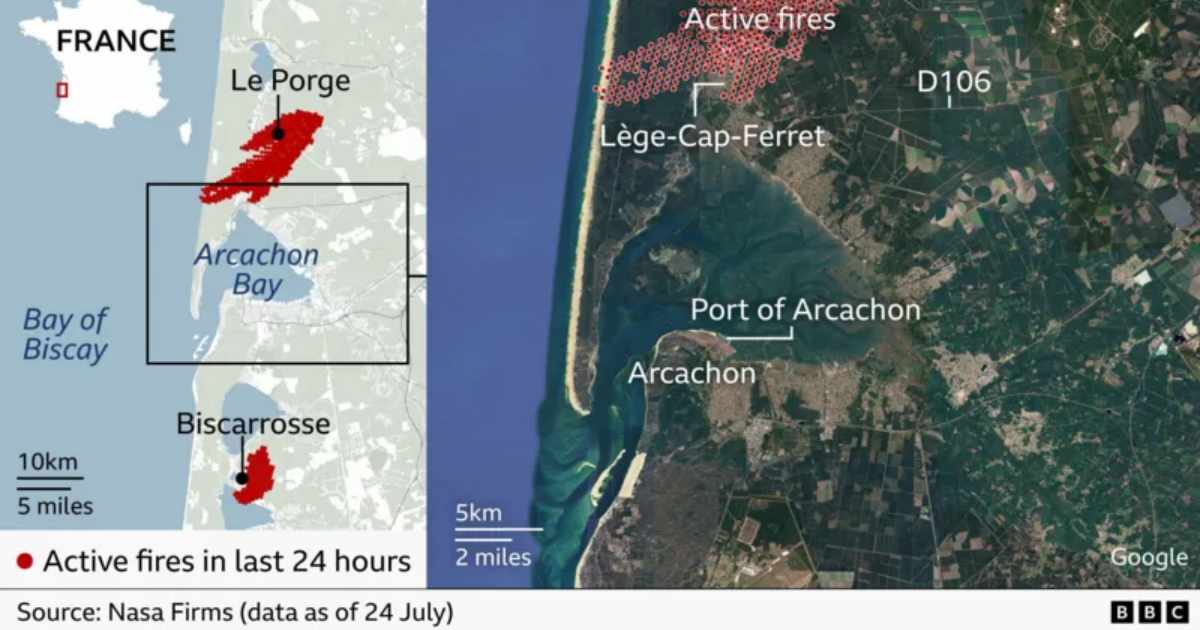
One of the worst-hit areas remains the Cap Ferret peninsula, a popular Atlantic holiday destination where around 44,000 people were evacuated. Hundreds escaped by boat across Arcachon Bay while thousands more fled by road as flames threatened the peninsula’s only exit route.
Local officials say the Gironde wildfire has already burned through more than 19,000 hectares of forest and destroyed around 80 homes, with firefighters describing it as an “XXL fire.” More than 50 firefighters have also been injured during the response.
Another major blaze near Biscarrosse in the Landes region forced over 23,000 people from homes, campsites, a nursing home and a summer camp. Officials warned the fire was unlikely to be brought under control quickly as temperatures climbed to 36–37°C and winds reached 50 km/h.
French Prime Minister Sébastien Lecornu described the fires as reaching “a level that has never been seen before,” while Interior Minister Laurent Nuñez confirmed that nearly 98,000 hectares have burned across France in what he called a historic record.
President Emmanuel Macron has mobilized the military, deployed military aircraft to assist firefighting operations and activated the European Union’s Civil Protection Mechanism to receive additional aircraft and personnel from neighboring countries.
Spain Declares National Emergency Due To Wild Fires
Across the border, Spain is facing what regional leaders have described as an unprecedented wildfire emergency.
The government declared a national emergency after multiple fires west of Madrid merged into one enormous blaze. Authorities say around 70,000 people have now been evacuated while tens of thousands more have been instructed to remain indoors.
Madrid regional emergency chief Carlos Novillo warned that the fire is “at its peak” and currently beyond the capacity of firefighters to contain.
Regional President Isabel Díaz Ayuso called it the worst wildfire in Madrid’s history, blaming an alarming combination of extreme temperatures, powerful winds and several fire fronts merging into one massive inferno.
Emergency crews are particularly concerned that the Madrid blaze could merge with another major wildfire burning in neighboring Ávila province, creating an even larger fire zone.
So far, nearly 10,000 hectares have burned in the Madrid region, while another 13,000 to 15,000 hectares have been destroyed in Ávila.
Eight municipalities, including Chapinería, Navas del Rey, Colmenar del Arroyo, Robledo de Chavela and Zarzalejo, have been evacuated, while several nearby towns remain under lockdown.
Prime Minister Pedro Sánchez visited the emergency coordination center and said protecting lives remains the government’s highest priority.
“Our priority is to save lives and protect inhabited areas,” Sánchez said, warning that changing winds could make the coming hours especially difficult.
Residents Describe The Horrific Wild Fires
Thousands of residents and tourists have shared dramatic stories of fleeing advancing flames.
On Spain’s outskirts, 86-year-old Ecologio Cabrera said he had never witnessed anything like the wildfire forcing him from his village.
“If you don’t run from it and you try to face it, it devours you,” he said after taking shelter in a sports hall with hundreds of other evacuees.
In France, British tourists camping on the Cap Ferret peninsula described waking to emergency alerts before rushing to leave tents, vehicles and belongings behind as sirens echoed through the night.
Many evacuees escaped by boat while others spent hours driving through smoke-filled roads as emergency services directed traffic away from the advancing fires.

Europe Mobilizes International Response
The scale of the crisis has prompted one of Europe’s largest coordinated wildfire responses in recent years.
France has appealed for international help through the European Union, which has dispatched firefighting aircraft and helicopters to both France and Spain. Military units have also been deployed to protect communities and critical infrastructure threatened by the fires.
Firefighters from Paris have joined operations in southwestern France, while Spain’s Military Emergency Unit has focused on defending communities near El Escorial and other vulnerable areas west of Madrid.
Authorities continue investigating the causes of several fires. In Spain, police have arrested one person and are investigating another after officials suggested negligence involving heavy machinery may have sparked one of the major blazes.
Climate Change: Mother Nature Giving Us a Wake-Up Call
Scientists have been saying this for years and every summer seems determined to prove them right. Climate change isn’t some distant threat anymore. It’s burning forests, forcing hundreds of thousands of people from their homes and turning entire regions into tinderboxes.
Europe is now the fastest-warming continent on Earth, heating at more than twice the global average since the 1980s, according to the Copernicus Climate Change Service. Repeated heatwaves and prolonged drought have left forests bone dry, while strong winds are helping fires spread at terrifying speeds. In some cases, flames have raced across thousands of hectares in just a few hours.
The numbers are just as alarming. More land has already burned across Europe this year than the average annual total over the past two decades, according to the European Forest Fire Information System.
Yes, most wildfires still need a spark, whether it’s human negligence or lightning. But climate change is handing those sparks a can of gasoline. Hotter temperatures, drier landscapes and longer fire seasons mean fires ignite more easily, spread faster and become much harder to stop.
At this point, Mother Nature couldn’t be shouting any louder. But sure, let’s keep clearing forests, building endless energy-hungry data centers and asking AI whether our crush secretly likes us. The planet is literally on fire and somehow we’ve convinced ourselves that’s a problem for another day.
Frequently Asked Questions (FAQs)
Q1) How many people have been evacuated due to the France and Spain wild fires?
More than 250,000 people have been evacuated across both countries, making this one of Europe’s largest wildfire evacuations in recent years.
Q2) Why did Spain declare a national emergency?
Spain declared a national emergency after multiple wildfires merged west of Madrid, overwhelming firefighting efforts and forcing tens of thousands of residents to evacuate.
Q3) Which parts of France are most affected?
The worst-hit areas are the Gironde and Landes regions in southwestern France, including the Cap Ferret peninsula and suburbs surrounding Bordeaux.
Q4) Why are Europe’s wild fires becoming more severe?
Scientists say rising temperatures, prolonged drought and repeated heatwaves linked to climate change are creating drier vegetation and longer fire seasons, allowing wildfires to spread faster and burn more intensely.
Stay tuned to Brandsynario for latest news and updates

 Join a Channel
 Brandsynario
 Veryfilmi