

















At a time when climate vulnerability is rising and electricity prices are crippling households, the National Electric Power Regulatory Authority’s proposal to effectively end net metering risks undoing years of progress. That too, when Pakistan was just getting started with solar energy.
Through its newly issued draft “Prosumer Regulations, 2025,” NEPRA has proposed replacing the net-metering framework introduced in 2015 with a gross-billing system.
While the regulator argues that the changes are necessary to protect grid stability, the proposed overhaul sends a troubling signal: that Pakistan is retreating from one of its most successful green energy initiatives.
What is Net Metering, and Why Does It Work for Making Green Energy Effective
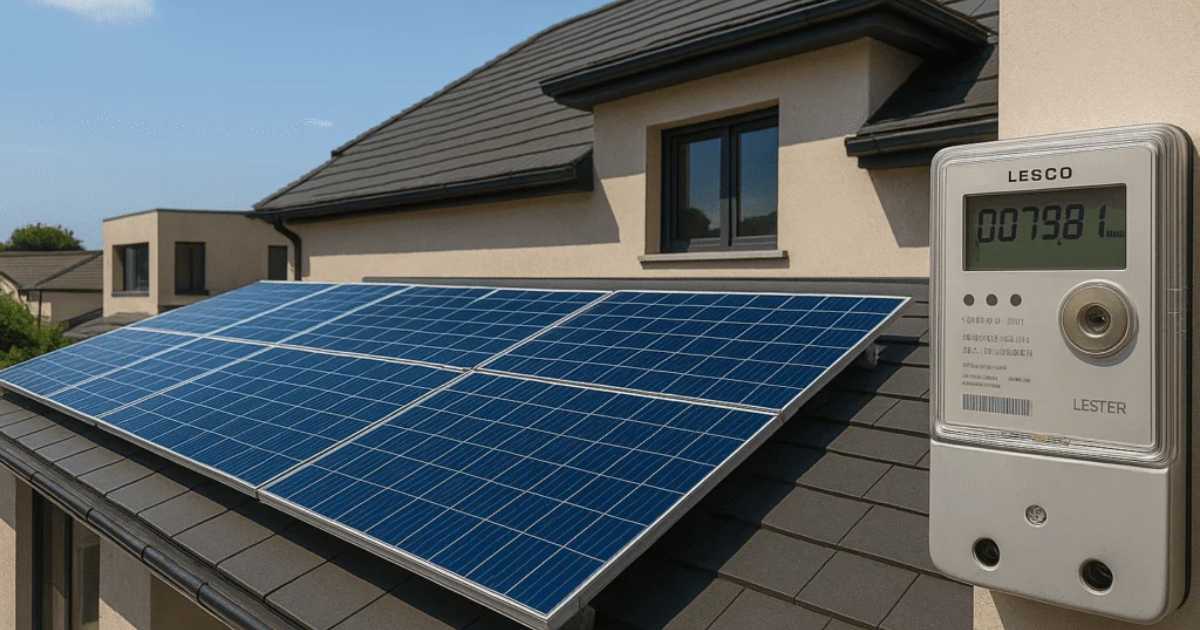
Net metering is a system that lets homes and businesses with solar panels use the national electricity grid like a battery.
During the day, when solar panels produce more electricity than a consumer needs, the extra power is sent to the grid. At night or during low sunlight, the consumer draws electricity back from the grid.
The key feature of net metering is that exported and imported electricity units are adjusted against each other at the same rate. If a consumer sends 100 extra units to the grid and later uses 100 units, they only pay for the difference.
This simple mechanism drove an unprecedented solar boom. Grid-connected solar capacity has crossed 6,000 megawatts, while total installed solar capacity has exceeded 13,000 megawatts.

For the first time, citizens were actively investing in clean energy not out of charity but because policy made economic sense.
Lowering Incentive to Install Solar Panels
Under NEPRA’s draft regulations, solar users will no longer be compensated at the same rate for the electricity they export to the grid.
Instead, surplus power will be purchased at the National Average Energy Purchase Price, estimated at around Rs. 13 per unit, nearly half the current rate of approximately Rs. 26 per unit.
At the same time, electricity drawn from the grid will continue to be billed at national tariffs ranging from Rs. 55 to Rs. 65 per unit. Imported and exported units will no longer be netted off. They will be calculated separately under a gross billing system.
In practical terms, this sharply reduces the financial incentive to install solar panels. It also pushes consumers toward installing battery storage so they can keep excess electricity for personal use rather than selling it cheaply to the grid.
NEPRA has also proposed limiting solar system sizes to a consumer’s approved electricity load, reducing contract durations from seven years to five years, and imposing transformer-level caps once solar penetration reaches 80% of capacity.
Larger systems of 250 kilowatts or more will require technical feasibility studies.
Existing net metering users will be protected only until their current seven-year contracts expire. After that, they too will be shifted to the new regime.
NEPRA Ends Net Metering: Is This A Step Back For Green Energy?
The stated justification for ending net metering is that it imposes costs on power producers and fails to recover grid and system costs.
Yet this argument remains contested.
On November 18, 2025, CPPA CEO Rehan Akhtar testified before NEPRA that while solar generation is increasing, its impact on the grid is not yet significant.
He noted that solar users are still drawing roughly the same amount of electricity from the grid as before, even as their overall consumption has increased due to the availability of solar power.
The deeper issue lies elsewhere. Poor energy planning and flawed contracts have locked the government into massive capacity payments for electricity that is often not consumed.
Instead of addressing these structural failures, the burden is now being shifted onto citizens who invested in clean energy. Are we even surprised?
While rooftop solar users are being paid Rs. 13 per unit or less, the government will continue to purchase electricity from solar IPPs at rates exceeding Rs. 49 per unit in dollar terms for years. The irony is hard to ignore.
Ending net metering after just a decade places Pakistan at odds with regional and global trends, too.
Neighbouring countries are expanding net metering and, in some cases, even allowing peer-to-peer energy trading between consumers.
Pakistan may become one of the few countries to roll back such a policy so early.
The environmental cost will also be significant. Reduced incentives will slow solar adoption, increase reliance on fossil fuels and raise carbon emissions. Yet the Ministry of Climate Change has remained conspicuously silent as one of the country’s most effective climate mitigation tools is weakened.
Do We Really Need to Get Rid of Net Metering?
There are smarter alternatives for both consumers and the government.
Instead of dismantling net metering, the government could introduce a national carbon-credit policy that allows solar consumers to transfer carbon credits to distribution companies.
These credits could be sold in international markets, improving DISCO’s finances without discouraging clean energy.
Another innovative solution could involve creating Digital Electricity Units Trusts in major cities.
Voluntarily donated solar units could be digitally transferred to nonprofit organisations and allocated to vulnerable households (i.e., widows and low-income families), aligning energy policy with social welfare.
Prime Minister Shehbaz Sharif has repeatedly emphasised the importance of solarisation and renewable energy. Preserving net metering would be consistent with that vision.
Weakening this might risk sending a message that Pakistan’s commitment to green energy is conditional and reversible.
Stay tuned to Brandsynario for latest news and updates

 Join a Channel
 Brandsynario
 Veryfilmi