












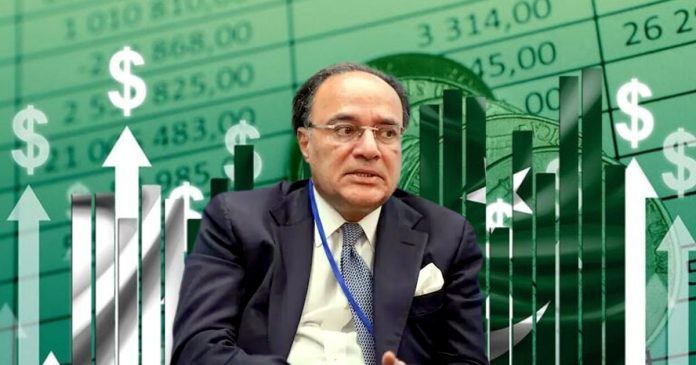

Pakistan’s Finance Minister Muhammad Aurangzeb said the country expects its economy to grow by 3.5% in the current fiscal year despite recent flood-related setbacks.
Speaking on CGTN America’s talk show ‘Heat’, he said that improved stability, lower inflation, and stronger foreign exchange reserves are helping sustain growth.
Aurangzeb noted that the government’s economic reforms are showing positive results. “Inflation is now in single digits, and the central bank’s monetary stance is dovish,” he said.
“Our foreign exchange reserves are sufficient to cover two and a half months of imports,” he added.
The finance minister said Pakistan’s economic performance has gained global recognition, as all three major international credit rating agencies have upgraded the country’s outlook.
He stated that Pakistan’s GDP grew by 3% in the last fiscal year and that economic fundamentals are continuing to strengthen.
“The target for growth this year was set at over 4%, though it may be slightly affected by the recent floods,” said Aurangzeb.
Aurangzeb also confirmed that Pakistan and the International Monetary Fund (IMF) have reached a staff-level agreement on a new loan programme.
This will allow the country to access $1.2 billion once approved by the IMF board. The package includes $1 billion under the Extended Fund Facility (EFF) and $200 million under the Resilience and Sustainability Facility (RSF), bringing total disbursements to about $3.3 billion.
Countries under IMF programmes must pass regular reviews, and once approved by the executive board, loan tranches are released.
The IMF said Pakistan’s recovery is “on track”, with inflation contained, external reserves improving, and financial conditions strengthening.
“Supported by the EFF, Pakistan’s economic programme is entrenching macroeconomic stability and rebuilding market confidence,” the IMF said in a statement.
CPEC and Investment Plans
Aurangzeb pointed to progress in the second phase of the China-Pakistan Economic Corridor (CPEC), noting that 24 joint projects were recently signed in Beijing. “New investment opportunities are also under consideration,” he added.
He also shared that Pakistan plans to return to international capital markets, beginning with its first green bond denominated in Chinese yuan by the end of the year.
This will be followed by an international bond worth at least $1 billion.
The IMF said Pakistan’s economic recovery has been supported by a tighter and data-driven monetary policy, while the government has pledged to strengthen climate resilience after the devastating floods.
The IMF’s financial assistance in September 2024 helped stabilise Pakistan’s $370 billion economy after a severe economic crisis that led to a sharp currency decline.
Stay tuned to Brandsynario for latest news and updates

 Join a Channel
 Brandsynario
 Veryfilmi