
















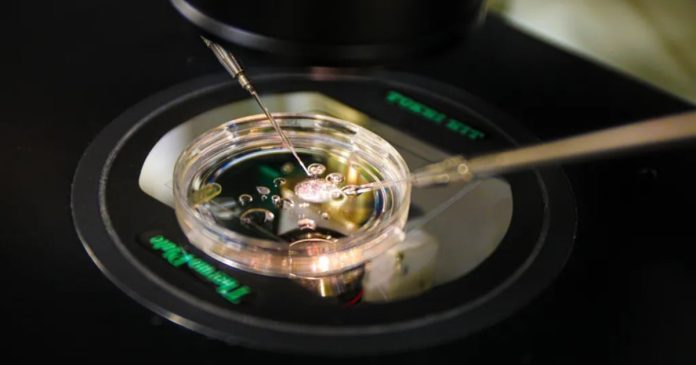

US scientists have, for the first time, created early-stage human embryos by manipulating DNA taken from people’s skin cells and then fertilising them with sperm.
A Potential Solution to Infertility
The breakthrough could pave the way for overcoming infertility caused by age or disease by using almost any cell in the body as the starting point for creating life. It may even allow same-sex couples to have a genetically related child.
However, the method still requires significant refinement for a decade or more before fertility clinics could consider using it. Experts have praised the achievement but emphasised the need for open public discussions about the ethical and societal implications of such advances.
Traditionally, reproduction has followed a simple path: a man’s sperm meets a woman’s egg, they fuse to form an embryo, and nine months later, a baby is born. But scientists are now rewriting those rules.
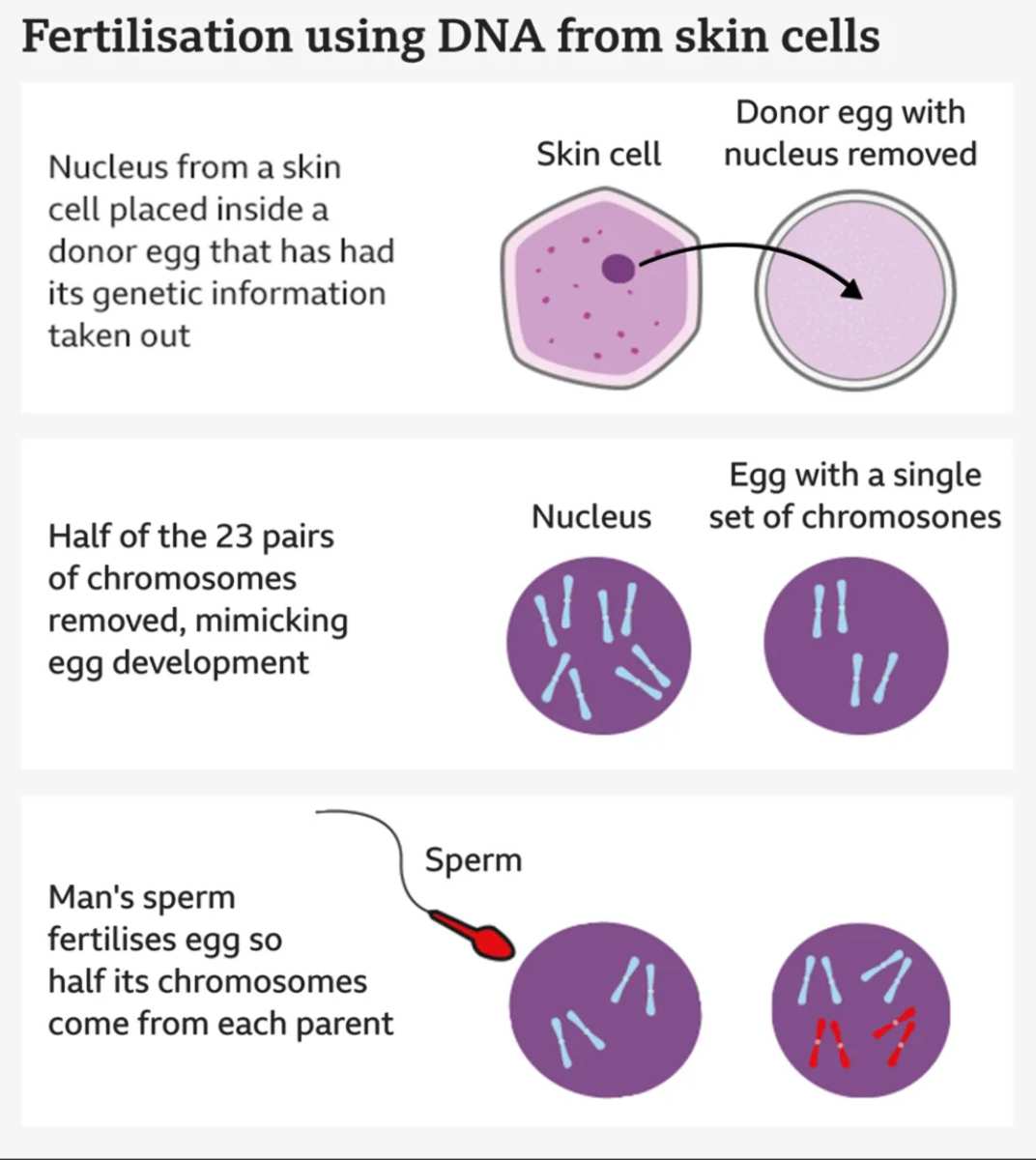
In this new experiment, researchers from Oregon Health and Science University (OHSU) began with a human skin cell. They extracted the nucleus that which contains the complete genetic code required to build a body. And then inserted it into a donor egg that had been stripped of its own DNA.
This process is similar to the technique used to clone Dolly the Sheep, the world’s first cloned mammal, in 1996.
The Process of “Mitomeiosis”
At this stage, the egg contains a full set of chromosomes (46 in total), just like a typical body cell, and is therefore not yet ready to be fertilised. To make it viable, researchers had to induce the egg to discard half of its chromosomes, mimicking a natural egg cell that carries only 23.
They named this process “mitomeiosis,” a blend of mitosis (normal cell division) and meiosis (the specialised division that produces sperm and egg cells).
In their study, published in Nature Communications, the team successfully created 82 functional eggs. After fertilisation with sperm, several developed into early-stage embryos, none progressing beyond six days of development.
“We achieved something that was thought to be impossible,” said Professor Shoukhrat Mitalipov, director of OHSU’s Centre for Embryonic Cell and Gene Therapy.
Still, the process is far from perfect. The egg discards chromosomes at random, sometimes losing or duplicating certain types, which could lead to genetic abnormalities. The success rate is low (around 9%) and the chromosomes skip a crucial reshuffling step called “crossing over,” which helps ensure healthy genetic diversity.
“We have to perfect it,” Prof. Mitalipov noted. “Eventually, I think that’s where the future will go, because there are more and more patients who cannot have children.”
This technology is part of a growing field known as in vitro gametogenesis, which seeks to create sperm and eggs outside the human body. While still in the research stage, the goal is to help couples who cannot benefit from IVF because they lack viable sperm or eggs.
The approach could assist older women whose eggs are no longer viable, men who produce too few sperm, or individuals rendered infertile by cancer treatment.
“In addition to offering hope for millions of people with infertility, this method could allow same-sex couples to have a child genetically related to both partners,” said Professor Paula Amato of OHSU.
Ethical and Regulatory Considerations
Experts have hailed the findings as an important scientific advance while urging transparency and public engagement.
Professor Roger Sturmey, a reproductive medicine expert at the University of Hull, called the work “impressive and important,” adding:
“Such research highlights the importance of open dialogue with the public about new advances in reproductive science. Breakthroughs like this reinforce the need for robust governance to ensure accountability and build public trust.”
Professor Richard Anderson, deputy director of the MRC Centre for Reproductive Health at the University of Edinburgh, agreed:
“The ability to generate new eggs would be a major advance. There will be very important safety concerns, but this study is a step toward helping many women have their own genetic children.”
The breakthrough is an “exciting proof of concept,” according to Ying Cheong, a professor of reproductive medicine at the University of Southampton and honorary consultant in reproductive medicine and surgery.
Stay tuned to Brandsynario for latest news and updates