















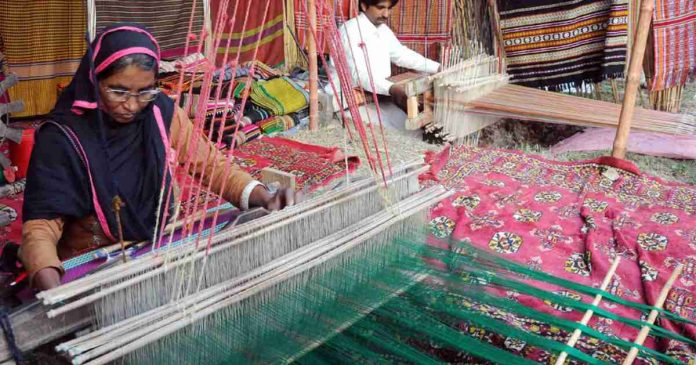

When it comes to cultural and traditional skills like weaving, Pakistan has always had the upper hand. In villages and towns like Sheikhupura, generations of skilled women weavers transform raw yarn into masterpieces through their hard work and unmatched perfection. Their talent and expertise are not only recognised in Pakistan but worldwide too, as their hand-woven carpets adorn homes and halls.
These women are not just weaving carpets but also their future, their means of livelihood and the honour of Pakistan with their work.
Carpets of Sheikhupura
In the quiet village of Feroze Wattwan in Sheikhupura, women sit at their looms, not just weaving carpets but weaving their own future. Their art produces carpets that are not just the face of Punjab but the whole of Pakistan too.
Each morning, when the day’s chores fade into the hum of thread and colour, they begin their eight-hour dance with the loom. Their fingers move with purpose, knot by knot, creating rugs that carry the soul of Punjab to distant homes and hearts.
Despite working for 8 hours daily, one carpet takes at least 3 to 4 days to complete from hand through “Khaadi” (the process of hand spinning yarn).
Here, care runs as deep as craft. The women receive physiotherapy to soothe tired muscles, and just beyond the workshop walls, their children learn and laugh in nearby classrooms. In every thread they tie, hope and heritage intertwine with a quiet promise that their art and their strength will endure.
Carpet Weaving History of Pakistan
The art of carpet weaving in Pakistan dates back centuries, tracing its roots to the Mughal era. When Emperor Akbar invited Persian artisans to his court in the 16th century, they brought with them the intricate designs and techniques that would soon blend with South Asian motifs to create something uniquely local.
After the Partition in 1947, many skilled weavers migrated to Pakistan, particularly to Punjab and Khyber Pakhtunkhwa, giving birth to a flourishing cottage industry. The carpets produced in Lahore, Sheikhupura, Faisalabad, and Bahawalpur became renowned for their fine wool, vegetable dyes, and complex knotting techniques.
Over time, Pakistani carpets gained international recognition, with exports reaching Europe, the Middle East, and North America. However, modernisation and industrial competition have since slowed the momentum.
Today, only a fraction of the once-thriving artisan workforce remains active as most struggle to preserve their ancestral craft in an age of mechanisation and mass production.
CTI Chief Urges For Punjab’s Carpet Industry Revamp
Recognising the urgent need to revive this heritage, the Carpet Training Institute (CTI) has called for a comprehensive revamp of Punjab’s carpet sector. The CTI Chief recently highlighted how Pakistan’s handmade carpets — once among the top exports — have seen a significant decline due to a lack of innovation, insufficient training, and poor global marketing.
He emphasised that the government must step in to support artisans with skill development programs, modern design training, and financial incentives to sustain the industry. Moreover, collaboration between designers, exporters, and weavers could reintroduce Pakistani carpets to international luxury markets.
“The world is once again seeking authenticity and sustainability,” the CTI Chief stated. “Handwoven carpets from Punjab carry both, they are eco-friendly, ethically made, and culturally rich. All we need is the right support system to help our artisans thrive again.”
This renewed focus could breathe life into towns like Sheikhupura, where artisans still cling to their looms with pride. A revival of Punjab’s carpet industry would not only preserve a centuries-old tradition but also empower thousands of families who rely on this craft for their livelihoods.
Stay tuned to Brandsynario for latest news and updates

 Join a Channel
 Brandsynario
 Veryfilmi